The court · Bretha Étgid, “Judgments of Inadvertence”, the 7th and 8th centuries
The Smith’s Forge
A boy creeps up to a smith at work and is burned. Does the smith pay?
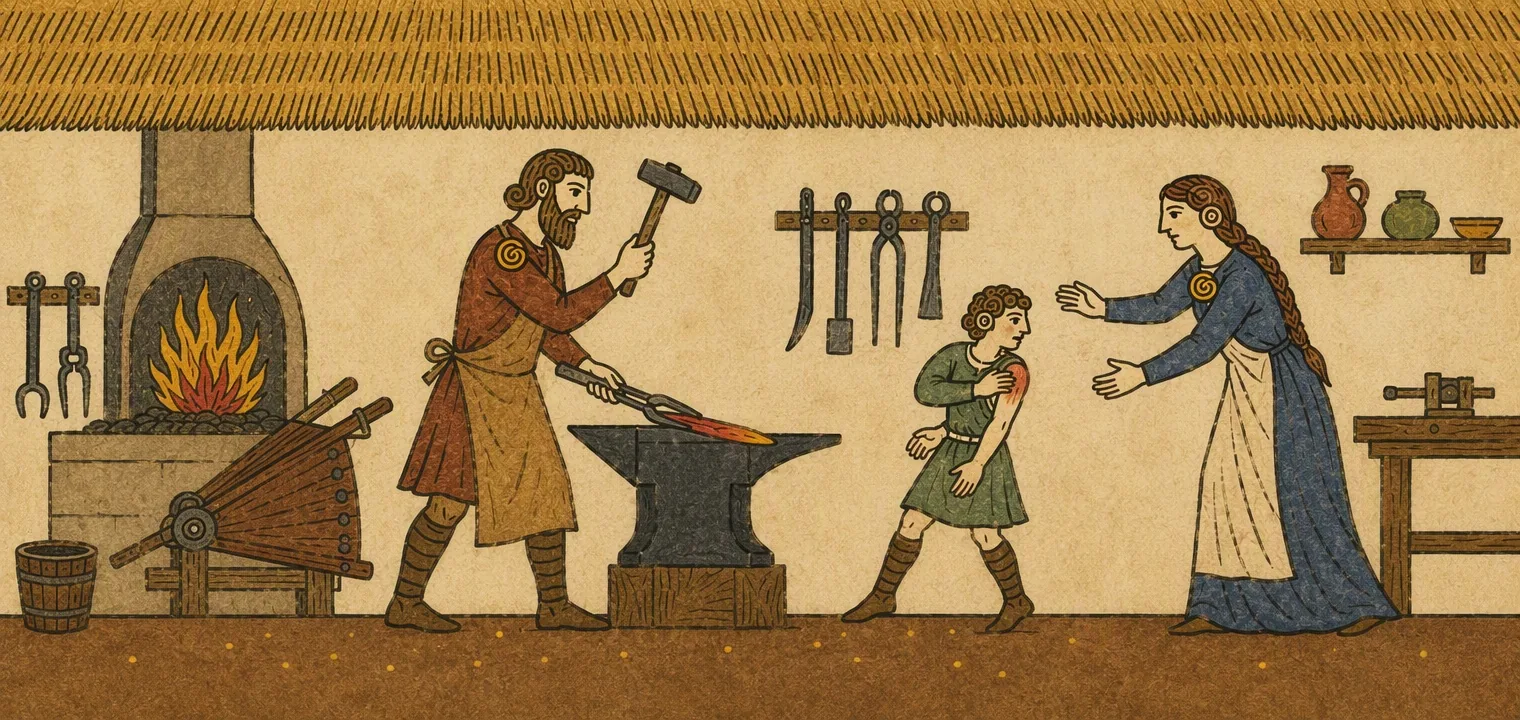
The scene Our telling
Donnchad had been at the anvil since dawn. Cormac crept in anyway, close enough to touch the bar. A spark leapt, and the boy cried out and ran home holding his arm.
The law
From the lawBretha Étgid is the main source for the early Irish law of accidents. Kelly says it describes each accident only very briefly, though it is usually clear what is meant. Its section on accidental injury is a section on 'immunity from liability', cases where the person who caused the harm does not pay.
GlossImmunity here means that the person who caused the harm owes nothing.
From the lawOne line reads, 'the immunity of hammers is an anvil'. Kelly presumes it means nobody pays when a person is killed or hurt after going too close to a smith at work. He lists the same for harm from a flail at a drying kiln, a flying chip during carpentry, and a mill while it is milling.
GlossKelly gives no reason for the anvil rule. For travellers in a ferry and people at a fair he says the law treats them as having chosen the risk, but he does not say this of the smith.
From the lawThere was liability, though, where a tool had a defect that nobody nearby had been told of. Kelly's examples are a hammer without its bolt and a billhook without its rivet, whose heads might fly off and hit a bystander.
GlossThe test in Kelly's account is whether the defect had been announced to those nearby. He does not say whether the owner knew of it.
Weigh it
Does Donnchad owe Cormac’s family compensation?
The commentary
Scholars sayThe old English translation, in the Ancient Laws of Ireland (volume 3), calls this text Lebar Aicle, 'the book of Aicill', a title Kelly calls incorrect. Binchy suggested that a group of texts, which includes Bretha Étgid, comes from a 'poetico-legal' school concerned with the rights and duties of men of art, especially poets. Kelly adds that there is some evidence linking that school to Munster.
Scholars sayThe text describes each accident very briefly, so Kelly writes 'presumably' of his reading of the anvil line. The rule rests on his reading. The scene above is our own, and nothing in Kelly turns on the smith having warned the boys.
Where we are not sure
Scholars sayKelly says Bretha Étgid gives each accident only briefly and he writes 'presumably' of the anvil line, so the rule rests on his reading. The word étged itself is translated differently: Kelly has 'negligence, inadvertence', McLeod 'irresponsible acts', and the old dictionary entry 'criminality caused by sheer wantonness' (Breatnach, Companion). No complete copy of the text survives. We have not read the Old Irish.
Where this comes from
- Fergus Kelly, A Guide to Early Irish Law (Dublin Institute for Advanced Studies, 1988), the section on accidents, citing Bretha Étgid at CIH 267.2 (the anvil) and CIH 273.29, 275.1 and 287.1.
- The Old Irish text we have not read ourselves; the rules above come from Kelly’s account of it.
Last checked against these books: 2026-10-04. How we read our sources · Corrections