Morann’s collar
Legend
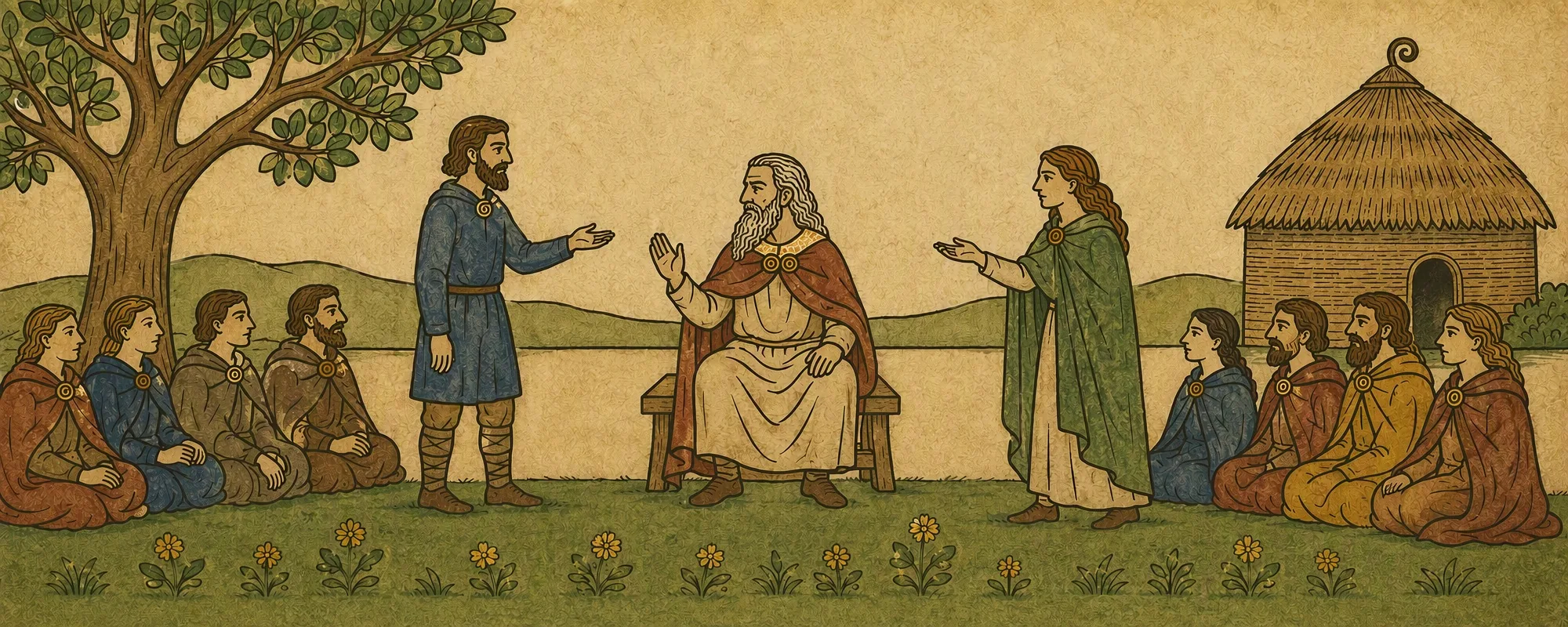
Morann is a judge of legend, and the stories give him a collar that could tell truth from falsehood. They do not agree about whose neck it went round.
 Morann is a judge of legend, and the stories give him a collar that could tell truth from falsehood. They do not agree about whose neck it went round.
The three collars
LegendA medieval tale lists twelve ordeals, ways of telling truth from falsehood, and Morann’s three collars come first. It says he was the son of Carpre Cat-head and was born with a membrane over his head. Nine waves of the sea washed over him, and the membrane came away and settled as a collar on his shoulders. It was covered in gold and silver and put round the neck of a person whose guilt was in doubt. In Whitley Stokes’s translation of 1891: “If he round whose neck it was put were guilty, it would choke him. If, however, he were innocent, it would expand round him to the ground.”
LegendThe second collar came from a fairy mound. It went round a person’s foot or hand, and closed on the false until it cut the limb off. The third was a letter from Paul the Apostle. The tale says that “when Morann used to deliver judgment he would put the epistle round his neck, and then he would never utter falsehood”.
The collar that tightens on the judge
LegendThe telling most people know is later. Geoffrey Keating, in the history of Ireland he wrote in the 1630s, says that “whoever wore it round his neck while delivering an unjust judgment the collar would close in tightly on his neck till he delivered a just judgment”. It did the same, he says, to anyone who came to give false testimony, until he had confessed the truth.
The older Morann
Scholars sayKelly calls Morann a legendary judge. The oldest text that carries his name has no collar in it. Audacht Morainn, “the testament of Morann”, is a text on kingship of the 7th century. Kelly describes it as addressed by Morann to his pupil Neire, and Jaski as Morann’s advice to a king. Jaski quotes from it: “let him preserve justice, it will preserve him”.
These are stories, not law. Kelly’s account of the ordeals named in the law-texts, such as the ordeal of the cauldron, draws on the same medieval tale, but the collar is not among the ordeals he describes. The stories say what the people who told them wanted from their judges.
On each case page you are asked what you would decide before you read the law. The collar is only the legend; the page does not grade you.
Where this comes from
- Whitley Stokes (editor and translator), “The Irish Ordeals, Cormac’s Adventure in the Land of Promise, and the Decision as to Cormac’s Sword”, Irische Texte, volume 3, part 1 (Leipzig, 1891). The collars are at pp. 206 to 209. Read in the copy published by CELT, University College Cork.
- Geoffrey Keating, Foras Feasa ar Éirinn, book 1, section 38, in the translation published by the Irish Texts Society. Read in the copy published by CELT.
- Fergus Kelly, A Guide to Early Irish Law (1988), pp. 209 to 211 on ordeals, pp. 235 to 236 and Appendix 2, no. 1, on Morann and Audacht Morainn.
- Bart Jaski, Early Irish Kingship and Succession (2000), p. 73.