The court · Bretha Étgid, “Judgments of Inadvertence”, the 7th and 8th centuries
The Woodcutter’s Shout
A felled tree strikes a passer-by. Does the woodcutter pay?
The scene Our telling
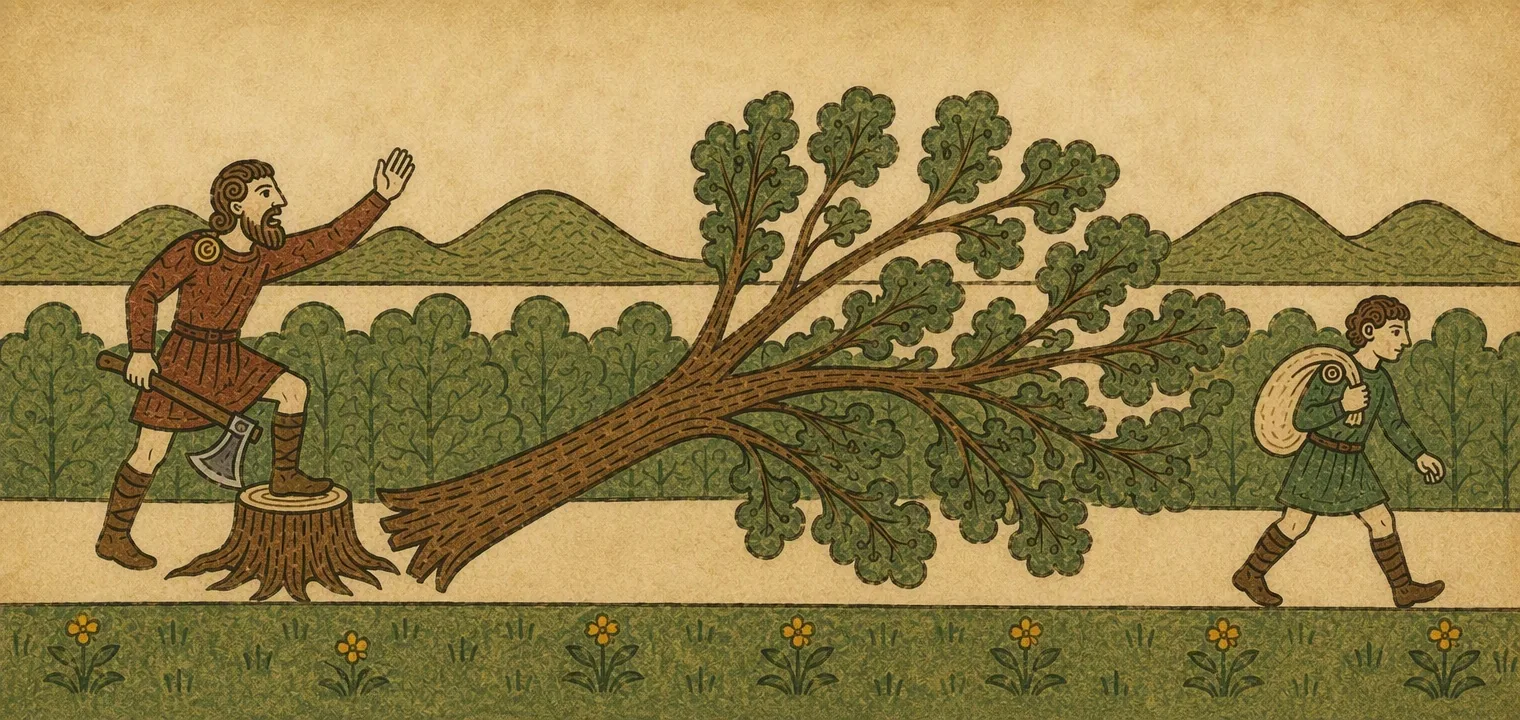
Diarmait was taking down an ash for his cart-poles. He worked the last cut quickly, and the tree went over across the path where the miller's boy was walking. It caught him on the shoulder.
The law
From the lawBretha Étgid deals with accidents for which the person who caused the harm is not liable. Kelly names harm from a flail at a drying kiln, a flying chip during carpentry, and a mill during milling. He reads a line about the 'immunity of hammers' as probably meaning that a person hurt by going too near a working smith cannot claim. Kelly then adds that in some cases there is liability.
GlossThese are Kelly's examples from the tract. He writes 'probably' of the anvil line.
From the lawThere is liability when a tree-cutter gives no shout of warning before a tree falls and someone is killed or hurt. Kelly lists two other cases where harm is the maker's or user's responsibility. One is a tool with a fault that those nearby had not been told about, for example a hammer with no bolt or a billhook with no rivet, where the head might fly off. The other is hurt from taking meat out of a cauldron with a flesh-fork when no warning was given.
GlossThe rule turns on the shout. Kelly records that a tree-cutter who gives no warning is liable, and he gives no reason beyond that.
Weigh it
Diarmait gave no shout. Does he owe the miller’s boy’s family?
The commentary
Scholars sayCompare the case of the smith's forge. Kelly reads the 'immunity of hammers is an anvil' as probably meaning there is no liability when someone is hurt by going too near a working smith. A hammer with a fault that was not announced to those nearby is a case of liability. Kelly does not say why the law draws the line there.
Where we are not sure
Scholars sayKelly says Bretha Étgid 'gives only the briefest description of each accident', so some readings are his. He marks the anvil line with 'presumably'. For the falling tree he gives the rule without noting any dispute. He does not say what the tree-cutter owes, or who decides whether a shout was heard.
Where this comes from
- Fergus Kelly, A Guide to Early Irish Law (1988), the section on accidents, citing Bretha Étgid at CIH 274.17–8 (the falling tree), CIH 267.2 (the anvil line), CIH 273.29 (the kiln flail), CIH 275.1 (carpentry) and CIH 283.32–4 (the cauldron and fork). Kelly, pp. 149 to 151.
- We have read Kelly’s account, not the Old Irish text.
Last checked against these books: 2026-10-04. How we read our sources · Corrections