The court · Bretha Comaithchesa, “Judgments of Neighbourhood”, the 7th and 8th centuries
The Felled Oak
A man cuts down an oak that stands on his neighbour’s land. What does he owe?
The scene Our telling
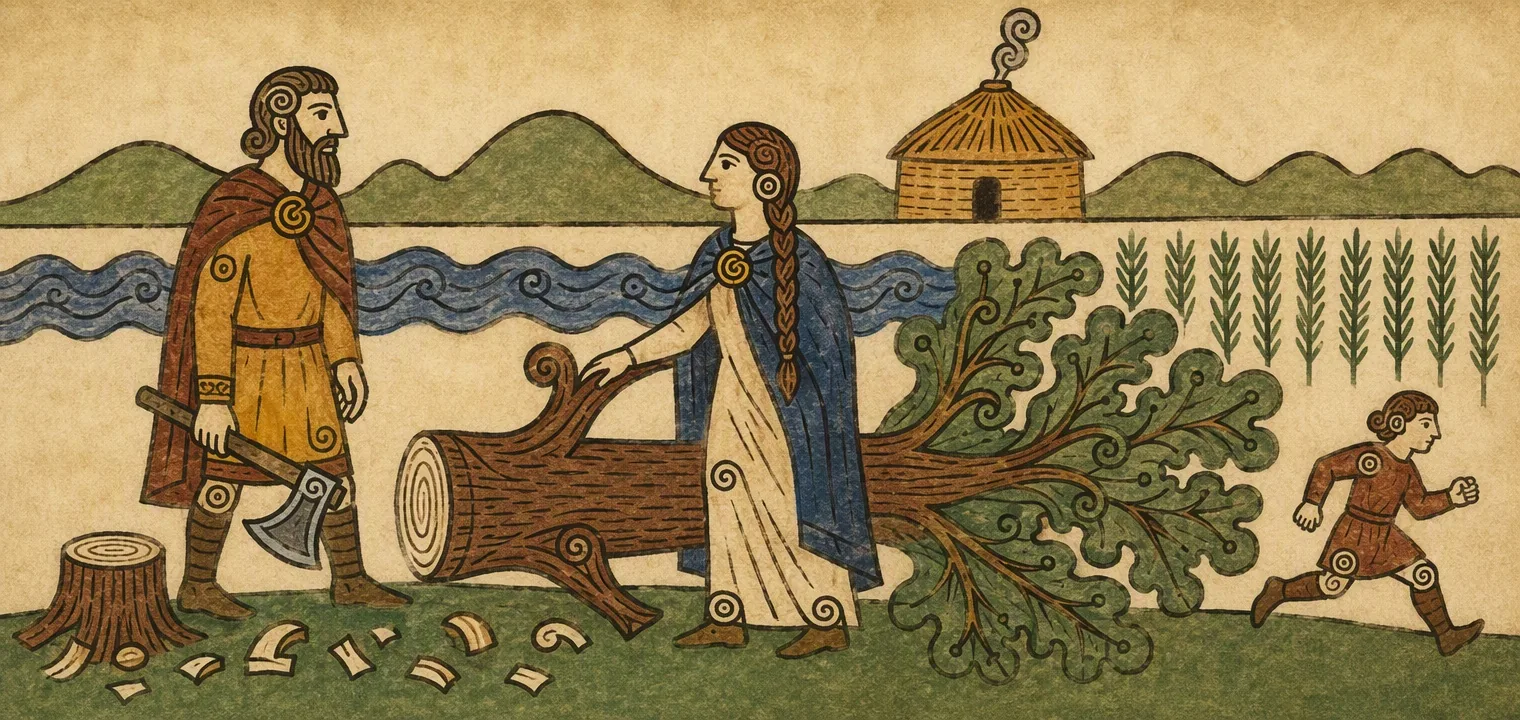
Fiachra had wanted the light for his barley for three summers. The oak stood on Brónach’s side of the stream, and its shadow lay across his best field from noon until evening. One morning in early summer he took an axe to it, and by dusk it was down.
Brónach did not shout. She walked the length of the fallen tree, counted its limbs, and sent a boy to fetch the judge.
The law
From the lawBretha Comaithchesa lists twenty-eight trees and shrubs in four groups of seven, ranked by their worth to a farmer. The top group, the nobles of the wood, was oak, hazel, holly, yew, ash, Scots pine and wild apple. Next came the commoners of the wood, then the lower divisions, then the bushes.
GlossKelly notes that the list shows a good deal of botanical knowledge and leaves out few native trees.
From the lawCutting a tree on another person's land carried a penalty-fine that depended on the group: five sets for a noble of the wood, a milch cow for a commoner, a yearling heifer for a lower tree and a sheep for a bush. For a noble tree the culprit also owed restitution that grew with the harm done. It was a yearling heifer for a branch, a two-year-old heifer for a fork (a large limb) and a milch cow for cutting it through at the base. The main text does not give full restitution figures for the other three groups.
GlossCattle were the normal currency. A set was a unit of value, usually taken as half a milch cow, so five sets would usually be about two and a half cows. Críth Gablach puts the set higher, at four fifths of a cow, so the sum is not fixed.
From the lawSome trees were classed as nemed, meaning privileged, and cost far more. The fine for a nemed apple tree was twenty sets, four times that for an ordinary one. A glossator on Bechbretha says a tree growing on the land of a nemed person counts as nemed.
GlossThe price of a tree could depend on whose land it stood on.
Weigh it
What should the judge order Fiachra to pay?
The commentary
Scholars sayThe groups follow economic value. An old commentary names what each noble was prized for, the oak for its acorns and its woodwork and the hazel for its nuts and rods. Kelly notes that the text counts the kind of tree but not its size, so a small oak and a very tall one apparently pay the same. A later commentary, which may come from a lost text on trees, outlines a fairer but more complex scale that separates large trees from slender ones.
Scholars sayThe fine is set by the kind of tree and the kind of cut. Nothing in the rules Kelly sets out makes the cutter’s reason, such as Fiachra’s shade, a defence. The tree was Brónach’s.
Where we are not sure
Scholars sayKelly says the main text gives full restitution figures only for the noble trees, and that an old commentary differs from it in small points for the other groups (for a branch of a commoner it gives a sheep where the text gives a yearling heifer). He is unsure of the meaning of two tree names, idath and crann fir, and of spin. The size rule rests on his word 'apparently'. He notes no dispute over the five-set fine for a noble tree, and we have not read the Old Irish.
Where this comes from
- Fergus Kelly, Early Irish Farming (Dublin Institute for Advanced Studies, 1997), the chapter on trees and woodland: the tree-list and the fines for damage to trees, citing Bretha Comaithchesa.
- Fergus Kelly, A Guide to Early Irish Law (1988), on damage to trees; and his paper “The Old Irish Tree-list”, Celtica 11 (1976). We read Kelly’s account, not the Old Irish text itself.
Last checked against these books: 2026-10-04. How we read our sources · Corrections