The court · Bechbretha, “Bee-Judgments”, between about 637 and 700
The Neighbour’s Apples
An apple tree on one man’s land drops its fruit on his neighbour’s. Whose is the fruit?
The scene Our telling
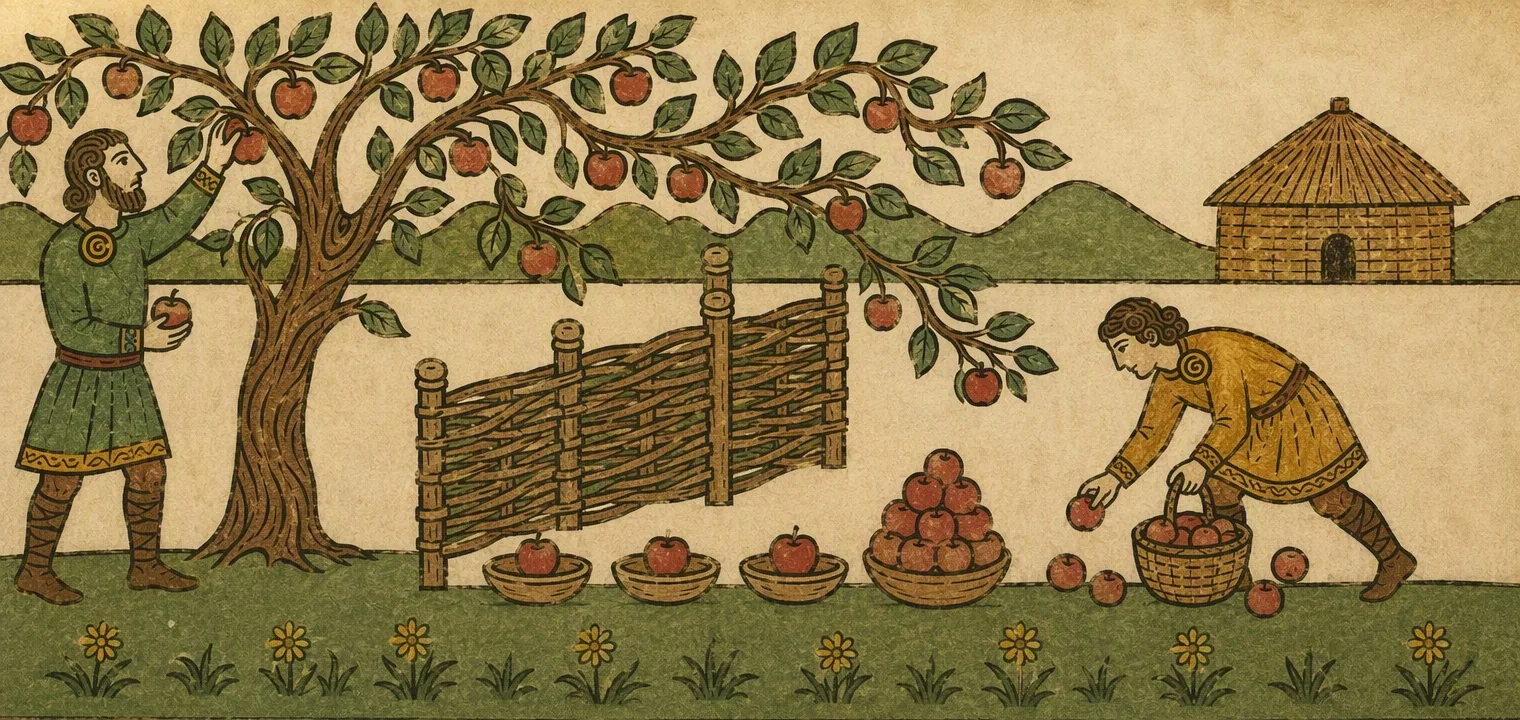
The apple tree stood by Ronán’s boundary. Half of it leaned over Tadhg’s side of the ditch, and every autumn the windfalls lay on Tadhg’s grass.
The law
From the lawKelly calls the fruit that falls on a neighbour’s land a notorious problem, and says Bechbretha treats it in an admirably fair manner. If a tree growing on A’s land drops fruit onto B’s land, the fruit is shared equally between them for three years. In the fourth year all of it goes to B, and in the fifth year the cycle begins again. The editors of Bechbretha read the case as a tree standing on a boundary with some of its branches over the neighbour's land, and they think the rule concerns only the fruit that falls on that land.
GlossNeither claim is brushed aside. In three years of the four the owner of the tree and the neighbour share the fruit equally. In the fourth year the neighbour takes it all.
From the lawIf either of the two destroys the tree, he pays the other a half fine, set by the rank of that tree (the verb is a tentative reading by the editors). A separate paragraph deals with lopping, and says the fine is higher where the tree has sacred status. A gloss says this depends on the rank of the person who owns the tree.
GlossThe editors of Bechbretha say the solution favours the neighbour, though the owner of the tree keeps some weight to his claim. The text gives no reason for the fourth-year rule.
From the lawThe owner of the tree's trunk is required to make an enclosure around its fruit, according to the glosses, so that the neighbour's land is not damaged.
GlossThe editors call the reason in the gloss uncertain and the key word 'obscure'.
Weigh it
In the fourth year, whose are the apples that fall on Tadhg’s grass?
The commentary
Scholars sayThe editors of Bechbretha treat §§12 to 17 as a side-discussion of tree-judgments. Kelly thinks it possible that §§12 to 16 come from a lost text, Fidbretha. The glossators are unsure about some words, for example the reason given for an enclosure, so we follow Kelly's summary of the rule.
Where we are not sure
Scholars sayKelly gives the fruit rule in three sentences and notes no dispute. The editors of Bechbretha say that the glossators disagree about some words. In §12 the word for the reason for the enclosure around the fruit is obscure and 'uncertain'. In §14 the verb 'destroys' is a tentative emendation. Binchy would read the subject of 'deposits' as the fruit and not the tree, and the editors call that reading equally good. They also say it is unclear whether the higher fine for cutting a tree of nemed rank applies to the lower classes of tree.
Where this comes from
- Fergus Kelly, A Guide to Early Irish Law (1988), the section on neighbours’ rights, citing Bechbretha §§12–13 for the fruit (Guide p. 109). The half fine and the point on sacred trees come from Bechbretha §§14 to 15, not from Kelly's paragraph.
- T. M. Charles-Edwards and Fergus Kelly, Bechbretha (1983), §§12 to 16 and the notes.
Last checked against these books: 2026-10-04. How we read our sources · Corrections