The court · Bretha Comaithchesa, “Judgments of Neighbourhood”, the 7th and 8th centuries
The Rooting Pigs
A neighbour’s pigs tear up your field. How does the law decide when you can graze it again?
The scene Our telling
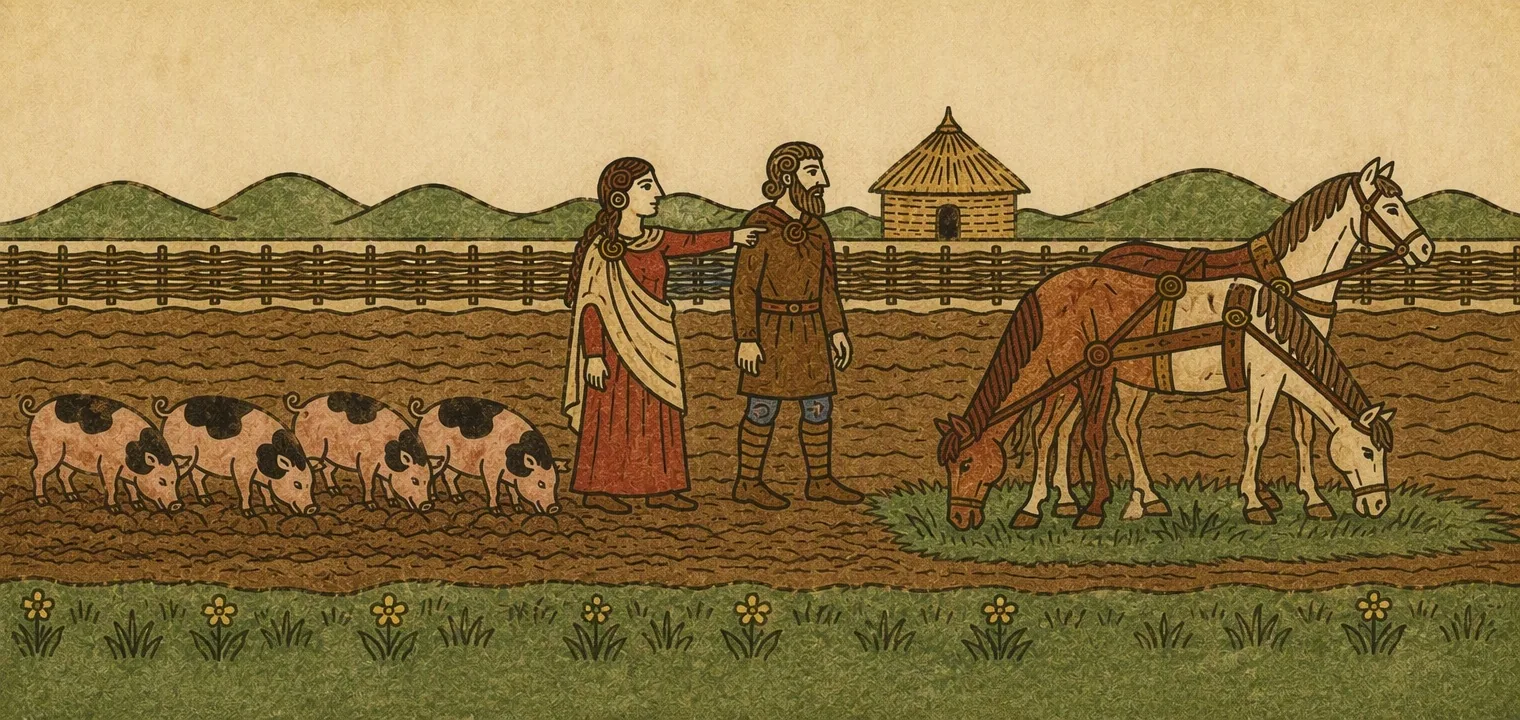
Conall’s pigs broke through and turned the lower field over like a ploughed bed. Eithne walked it at dawn, and then she sent for her neighbour.
The law
From the lawIf pigs only crop the grass of a neighbour’s field, they pay the same fine as other animals. If they root up the ground, their owner has to lend the neighbour other land until the damaged field has been put back as it was.
GlossCropping and rooting are two different harms, and the law treats them differently.
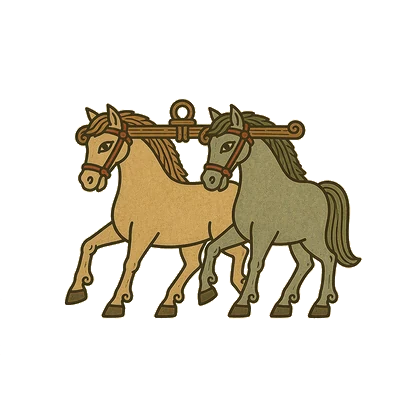
From the lawKelly describes an ingenious test for when the field can be grazed again. Two yoked horses are let loose in it, and if no earth sticks to their teeth as they graze, the field is fit.
GlossA test anyone could see: earth on the horses’ teeth, or none.
From the lawOther rules for animal trespass in general apply too, though Kelly does not name pigs in them. Trespass at night costs twice as much as trespass by day, because cattle ought to be shut in at night. There is no liability where animals were chased onto the land by dogs or men, or frightened into it.
GlossThese are Kelly’s general rules for animal trespass. He does not apply them to pigs by name.
Weigh it
Conall’s pigs have rooted up the field. What does he owe?
The commentary
Scholars sayKelly calls the method of the horses ingenious, and gives no more detail.
Scholars sayPigs are one of the animals the law treats specially. For animal trespass in general Kelly says the aim is to match the compensation to the damage: cattle in a meadow pay twice what they pay in moorland or aftergrass, and grazing trespass in winter, when grass is scarce, costs more than in summer.
Where we are not sure
Scholars sayKelly gives the rule for rooting pigs without noting a dispute (CIH 72.1–4). He does not say how long the loan of land lasts beyond “until the damaged field has been restored”, or what the pig-owner’s fine is. Early Irish Farming adds fines in grain for each pig and a further procedure he calls impractical, which we have not yet checked.
Where this comes from
- Fergus Kelly, A Guide to Early Irish Law (Dublin Institute for Advanced Studies, 1988), the section on animal trespass, citing Bretha Comaithchesa (CIH 72.1–4, the pigs).
- We have read Kelly’s account, not the Old Irish text.
Last checked against these books: 2026-10-04. How we read our sources · Corrections