The court · Bechbretha, “Bee-Judgments”, between about 637 and 700
The Swarm in the Green
A man finds a stray swarm of bees. Whose is it?

The scene Our telling
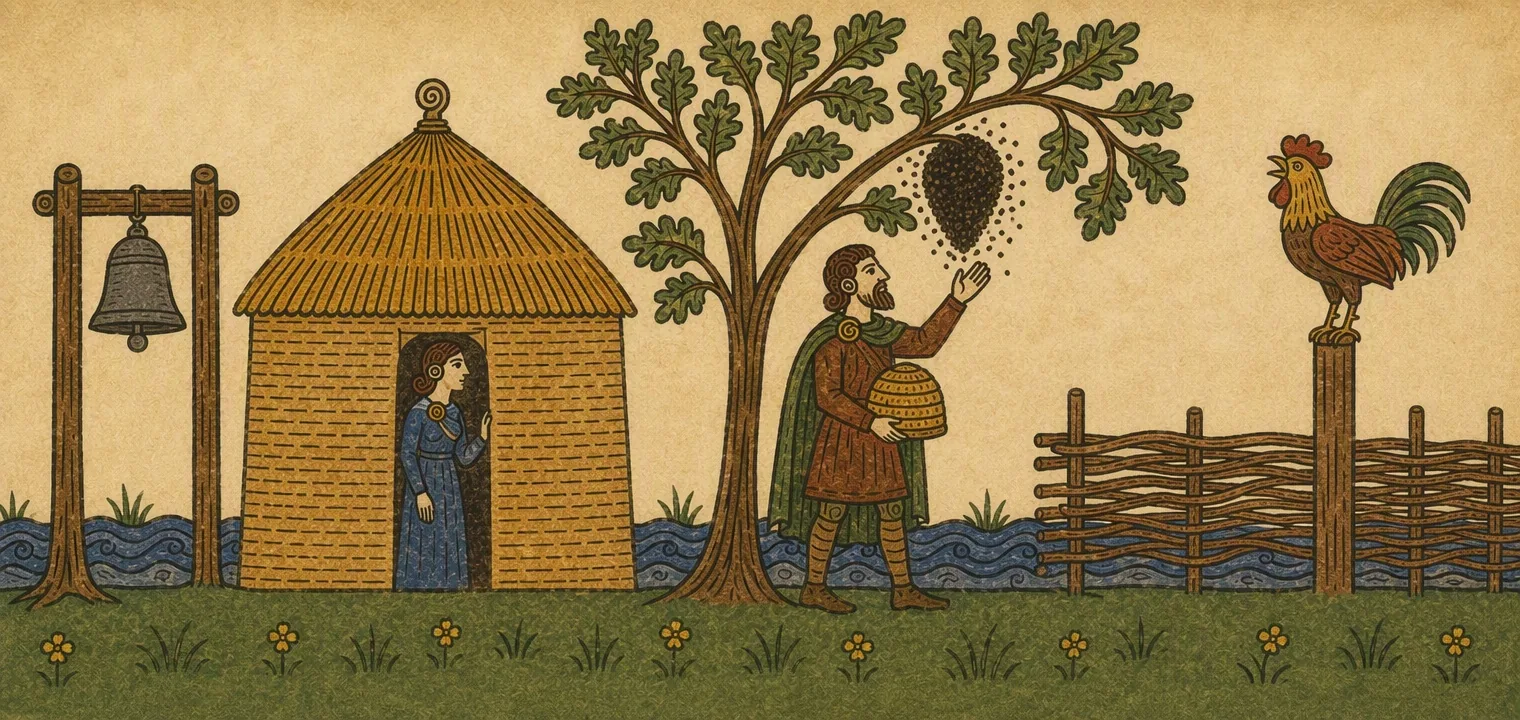
Muiris saw the swarm go over the wall and settle in the hawthorn on the far side. He had no idea whose it was, and he could hear the bell from the church while he looked at it.
The law
From the lawA man who finds a stray swarm in a lawful green is owed a quarter of its produce for a year. The other three quarters go to the owner of the green. A lawful green extends as far as the sound of a bell or the crowing of a cock.
GlossA lawful green is the land close to a farmhouse, marked out by how far a bell or a cock can be heard. The finder's share changes with the kind of ground: a quarter in the green, a third beyond it.
From the lawIf the finder comes upon a tree with bees in a lawful green, and the bees have been there more than a year, he has half and the owner of the green has half. The editors read this as an exception to the quarter rule, and a gloss says it penalises the owner for not walking round his green.
From the lawIf the swarm is found outside the green, up to a great forest, inaccessible country or unshared land, the finder has a third and the owner of the land two thirds. A swarm found in a great forest, in unshared land or in inaccessible country belongs to the finder, apart from a share to the head of his kin and a share to the church to which he makes a bequest. Kelly reads each of those two shares as a ninth of the honey.
GlossIn forest, unshared land and inaccessible country the swarm is the finder's. The text calls this one of the complete immunities in Irish law, and keeps the two shares for the head of his kin and the church.
From the lawWhere there are many hives and a swarm has escaped from each, and a swarm settles on a neighbour's land that is near to them all, and no one swears it was his, the owners share half of its produce for three years. The other half goes to the land where it settled.
GlossThis covers the case where the swarm's owner cannot be told (BB §45).
Weigh it
Muiris finds the swarm in a lawful green, within sound of the bell. What is his share?
The commentary
Scholars sayThe text sets out cases one after another: a quarter in the green, a half for a tree with bees there after a year, a third outside the green, and the whole swarm apart from two small shares in forest or unshared land. Kelly says the finder and the owner of the land share 'in varying proportions', and the sources give no single reason for the figures.
Scholars sayThe glosses add details the plain text does not have. One gloss on the third says the book does not say for certain whether it applies before or after a year. A gloss on the quarter says it is for bees there less than a year, and a half if longer. We keep to the plain text.
Where we are not sure
Scholars sayKelly says Bechbretha §§46 to 49 deal 'in great detail' with finders of stray swarms and gives the proportions as 'varying'. The editors note that the glossators disagree: one reads the quarter in §46 as covering only bees there less than a year, and another says the book does not make clear whether the third in §48 comes before or after a year. The editors also call the first glossator's view that the tree in §47 is a sacred tree 'quite unjustified by the text', and they say the ninth shares in §49 come from a gloss. They point out that if the rule was ever applied it would have been hard to prove how old a colony was.
Where this comes from
- T. M. Charles-Edwards and Fergus Kelly, Bechbretha (Early Irish Law Series 1, 1983): the Old Irish text, translation and notes for sections 45 to 49. We read their translation, not the Old Irish.
- Fergus Kelly, A Guide to Early Irish Law (1988), on a finder’s rights in unshared land.
Last checked against these books: 2026-10-04. How we read our sources · Corrections