The court · Bretha Comaithchesa, “Judgments of Neighbourhood”, the 7th and 8th centuries
The Dog on the Neighbour’s Land
A dog fouls a neighbour’s field. What does its owner owe?

The scene Our telling
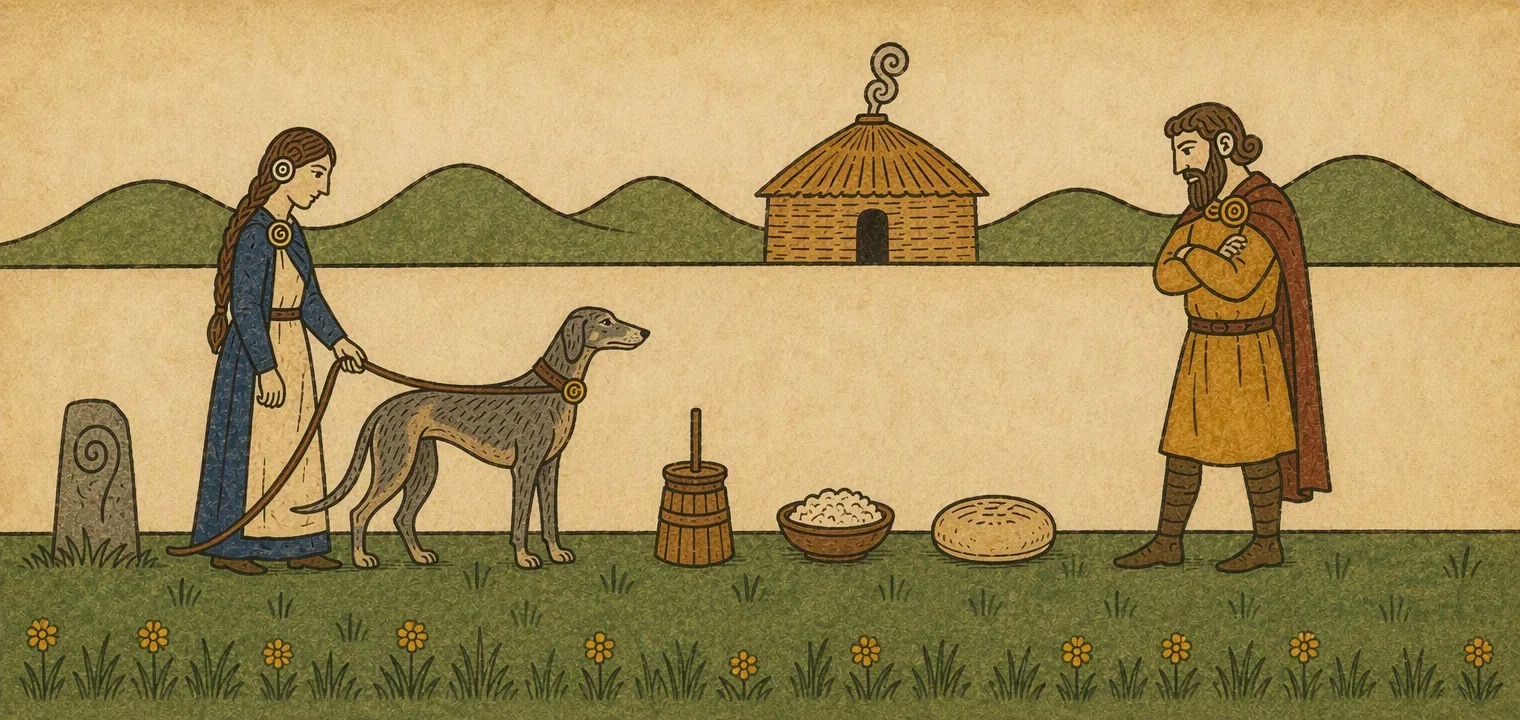
Sárnat’s hound had followed her to the boundary stone and gone on alone. By evening it had crossed her neighbour Ailbhe’s meadow, and it had not been tidy about it.
The law
From the lawMost of Bretha Comaithchesa deals with damage to a neighbour’s land and crops by animals. Each farmer gave his neighbours a fore-pledge, which was forfeit if his animals trespassed. In general the compensation was matched to the damage done: cattle that broke into meadow paid twice as much as cattle that broke into moorland or aftergrass, and grazing trespass in winter, when grass was scarce, cost more than in summer.
GlossA fore-pledge is something of value handed to a neighbour in advance, so that he already holds a security if the animals stray.
From the lawThe dog that fouls a neighbour’s land is an exception, and Kelly calls its treatment exceptional. Its owner has to remove the dirt, and has to give the neighbour the same quantity of butter, curds and dough.
GlossButter, curds and dough were everyday foods. Kelly does not say why these three were chosen.
From the lawA shorter text on distraint, which Kelly thinks is probably later, gives a procedure for a watch-dog that has done wrong. The injured party lays a plank across the dog’s feeding-trough and gives notice that it is not to be fed until the fine is paid. If the owner feeds it anyway, he becomes guilty of a “human offence”, which carries a much heavier fine than the dog’s own.
GlossDistraint was the pressure a creditor or injured party put on someone to make him pay. Here the pressure falls on the feeding of the dog.
Weigh it
What does Sárnat owe Ailbhe?
The commentary
Scholars sayKelly says the law clearly felt this to be a particularly polluting kind of trespass, and that is how he accounts for a rule so unlike the one for cattle. That is his reading. The text, as he gives it, states the rule without explaining it.
Where we are not sure
Scholars sayThe dog rule rests on one short passage (CIH 74.26–30). Kelly does not say what “the same quantity” is matched to; the faeces is the likely answer, but he does not say so. The watch-dog procedure comes from a text he calls probably later, and the sentence has no reference of its own. Early Irish Farming adds more on cleansing the soil, which we have not yet checked.
Where this comes from
- Fergus Kelly, A Guide to Early Irish Law (Dublin Institute for Advanced Studies, 1988), the section on animal trespass, citing Bretha Comaithchesa (CIH 74.26–30, the dog).
- We have read Kelly’s account, not the Old Irish text.
Last checked against these books: 2026-10-04. How we read our sources · Corrections