The court · Bretha Comaithchesa, “Judgments of Neighbourhood”, with its later commentary, the 7th and 8th centuries
The Pet Wolf
A tame wolf goes over the hedge and kills a neighbour’s hen. Who answers for a wild thing that has been made a pet?
Basis. Rests on Kelly’s account of the law, not on the Old Irish text itself. Open questions are set out below.
Topics: Animals on other people’s ground.
The scene Our telling
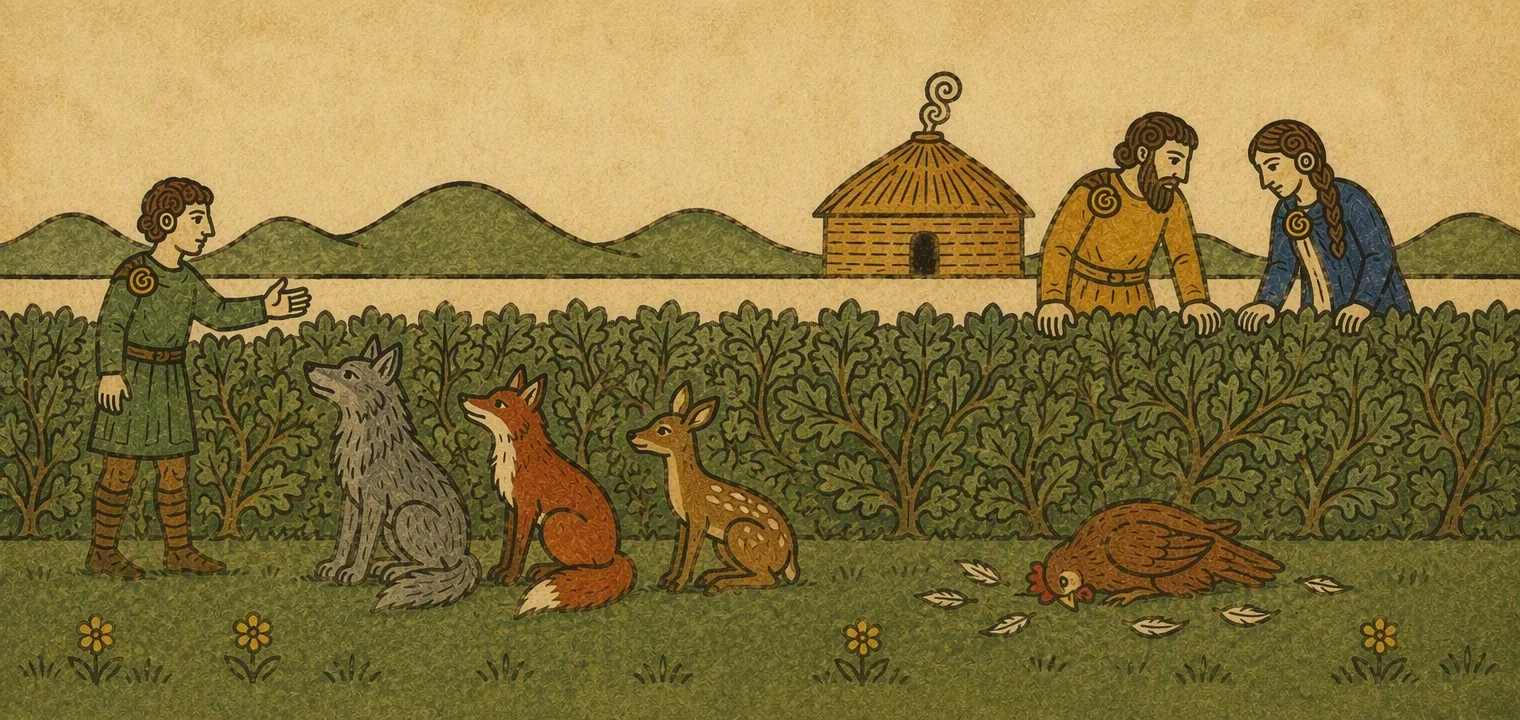
Fíonán had a way with wild things. He had reared a wolf from a cub, a fox from a kit and a fawn that had lost its mother, and all three came when he whistled. One morning the wolf went over the hedge, and a neighbour’s hen did not come back. He had fed that wolf from his hand through its first cold months. He had always known it was a wolf, and had never fully believed that it would act like one.
 Fíonán had a way with wild things. He had reared a wolf from a cub, a fox from a kit and a fawn that had lost its mother, and all three came when he whistled. One morning the wolf went over the hedge, and a neighbour’s hen did not come back. He had fed that wolf from his hand through its first cold months. He had always known it was a wolf, and had never fully believed that it would act like one.
The neighbours found the hen on his side of the hedge, in a scatter of feathers. They were not shouting. The hen had been one of their best layers. They leaned on the hedge and looked at the three animals sitting quiet in the grass, and then at him.
What would you decide?
Answer first, then read the law. Your first answer is the one kept. It is stored only on this device.
The wolf has killed the hen. Does Fíonán have to answer for it?
Read the law below and find the line that decides it. Is it a rule you would have guessed?
Read the law, the commentary and the sources
The law
The law, as Kelly gives itBretha Comaithchesa deals mainly with trespass by cattle and pigs, but it also mentions pets taken from the wild. Kelly’s Guide lists a pet wolf, fox, deer and heron, and a fifth that he gives as a crow, with a query. In each case, he says, the owner of the pet surrenders the fore-pledge to the landowner.
NoteA fore-pledge is something of value lodged with a neighbour in advance, against trespass by one’s animals. In Early Irish Farming Kelly says it guaranteed payment of the fine, and that in some cases, of which this is one, the pledge itself was forfeit.
The law, as Kelly gives itA later commentator on the text gives a much longer list of pets, and matches the offences each is likely to commit with those of an ordinary farm animal. He sets the wolf, the fox and the otter beside the dog, and the red squirrel and the stoat beside the cat. A tame wild pig that roots up a neighbour’s land pays the usual fines for pig-trespass.
NoteThis is commentary, written later than the law-text. Kelly calls the matching ingenious.
The law, as Kelly gives itThe law-texts sort the harm an animal does into two kinds. Where its owner showed no malice or neglect it is an “animal offence”, and the fine is smaller. Where he should have prevented it, it is a “human offence”. Kelly’s example is a horse that bites a passer-by. If it had never bitten before, its owner is liable only for an animal offence. If it was known to be a biter, he is liable for a human one.
NoteSo an owner answered either way. What he knew changed how much he owed.
The law, as Kelly gives itWhat was owed when one man’s animal killed another’s, Kelly gives in two ways. In Early Irish Farming the general rule, where the culprit can be identified, is that its owner compensates the owner of the victim, typically with an animal of the same quality. In the Guide, where two men’s animals graze together and one kills the other, the normal procedure is that the offender is killed and the meat of both is divided between the two owners.
NoteThe Irish word for the first kind of compensation is aithgein, restitution. The second rule is given of bullocks, and Kelly thinks it likely that it was modelled on the Book of Exodus.
The law, as Kelly gives itA third answer is found in other law-texts: the animal itself is forfeit to its victim. Kelly calls this a common penalty for a first offence by a domestic animal. Of a dog that attacks a person he reports both views. In one commentary the owner of a “dog of first offence” owes only medical care or recompense. In other texts the dog becomes the property of its victim, who can decide whether to kill it or to keep it.
NoteBretha Nemed Toísech says that all livestock are taken away for their first offence.
The commentary
Scholars sayNo text we have read deals with a pet wolf that kills a hen. The old text makes its owner answer for its trespass, and a commentator sets its offences beside the dog’s. What a judge would have awarded for the hen we cannot say: a hen as good, the wolf itself, or something else.
Scholars sayA pet and a hen do meet in the Latin Life of Saint Mo Ling, which Kelly cites, though there the pet is a fox. The saint kept a number of animals and fed them from his own hand. His fox once stole and ate a hen that belonged to his fellow monks, and through a miracle the bird was restored to life.
Where we are not sure
Scholars sayThe old text names three pet mammals: the fox, the wolf and the deer. Its two birds are less certain. The first may be a heron or a crane. The second Kelly’s Guide gives as a crow, with a query, and in Early Irish Farming he thinks the word could be applied to various birds of prey.
Scholars sayThe law-texts do not agree on what is owed when one animal kills another, or on an animal’s first offence. That is why our question asks only who answers, and not what he pays.
Where this comes from
- Fergus Kelly, A Guide to Early Irish Law (Dublin Institute for Advanced Studies, 1988), pp. 142 to 143, the section on animal trespass, citing Bretha Comaithchesa at CIH 73.19–20 (the pets); and p. 146 on one animal that kills another.
- Fergus Kelly, Early Irish Farming (Dublin Institute for Advanced Studies, 1997), pp. 124 to 130 on pets, the saint’s fox and the commentator’s list; pp. 134 to 135 on animal and human offences and on the fore-pledge; pp. 142, 149 and 154 on animals forfeit for a first offence; and p. 176 on one animal that kills another.
- We have read Kelly’s account, not the Old Irish text.
Last checked against these books: 2026-10-06. How we read our sources · Corrections