The court · Bretha Comaithchesa, “Judgments of Neighbourhood”, the 7th and 8th centuries
The Gap in the Fence
A neighbour’s oxen break through a poor fence and eat your barley. Can you claim?
The scene Our telling
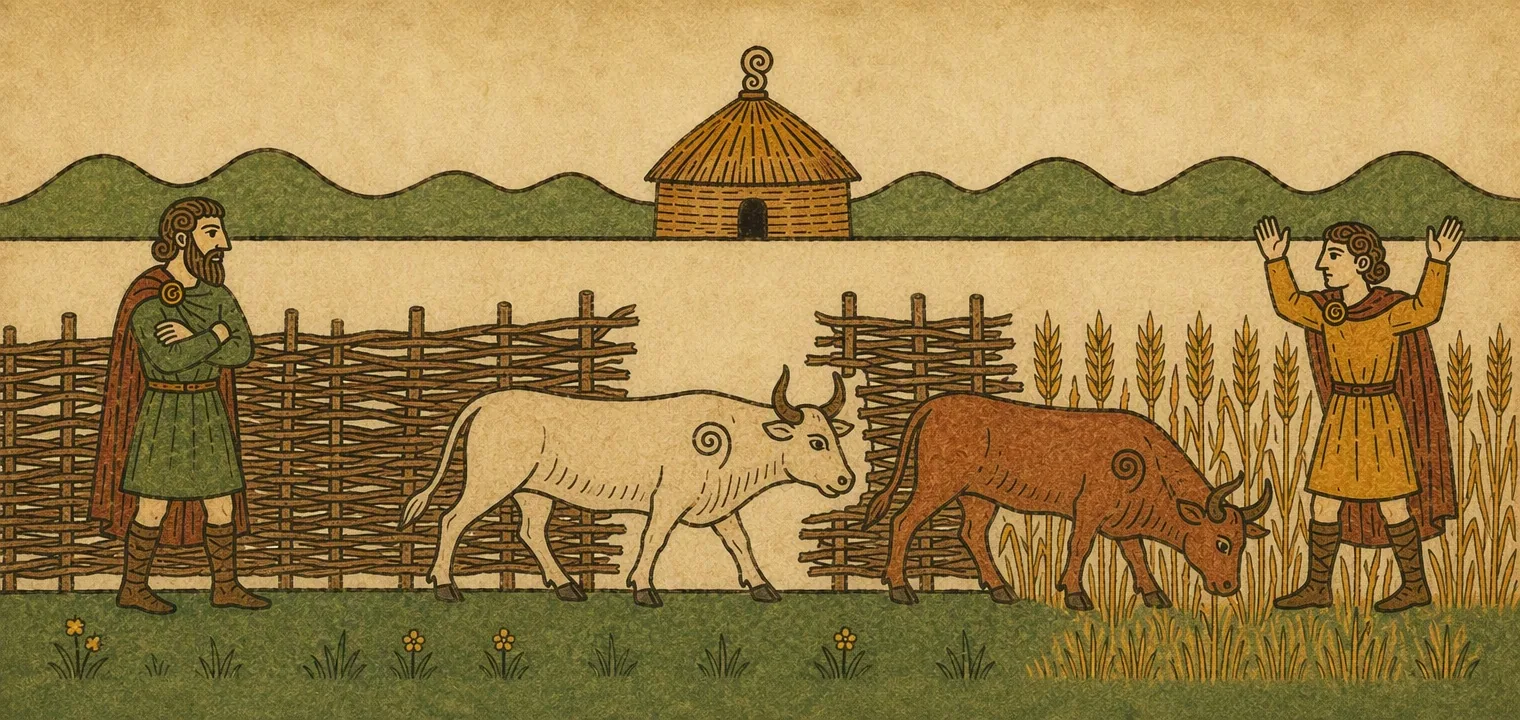
The wattle fence had stood for a year and a half, and a winter had left it thin along the lower field. Brónach’s oxen found the gap on the first warm night, and by morning the barley was flattened.
The law
From the lawNaturally, Kelly says, a landowner cannot claim for damage done by a neighbour’s animals if his own fences are inadequate. For that reason Bretha Comaithchesa describes in detail the construction and dimensions of the four legally approved kinds of fence and wall.
GlossKelly presents this as following naturally from the fore-pledge system: a farmer who leaves his own fence inadequate cannot expect the law to make up the loss.
From the lawA post-and-wattle fence must be built so that a small animal cannot get through it because of its closeness, and an ox cannot get over it because of its height and firmness.
GlossKelly calls the legal dimensions of fences in this text realistic.
From the lawSome trespass carries no liability whatever the state of the fence: cows in heat, rutting rams, bulling bulls and the like, because no fence could reasonably be expected to hold them. Nor is there liability where animals were chased onto the land by dogs or men, or frightened into it. And a farmer who deliberately breaks down a neighbour’s fence commits “human trespass”, which carries a heavier penalty than animal trespass.
Gloss“No liability” means the owner of the straying animals owes nothing. “Human trespass” means the law counted the harm as the owner’s own wrongdoing.
Weigh it
The fence did not meet the legal standard. Can the owner of the barley claim?
The commentary
Scholars sayKelly states the rule with “naturally”, as something that follows, and the text he cites (CIH 73.11–2) is the passage on the post-and-wattle fence. So the rule that an inadequate fence loses the claim is his statement of the principle, not a line he quotes.
Where we are not sure
Scholars sayKelly does not give the dimensions, or the other three kinds of fence, in this book, so we cannot say more about them. Otherwise he gives the rule without noting a dispute.
Where this comes from
- Fergus Kelly, A Guide to Early Irish Law (Dublin Institute for Advanced Studies, 1988), the section on animal trespass, citing Bretha Comaithchesa at CIH 73.11–2 (the fence).
- We have read Kelly’s account, not the Old Irish text.
Last checked against these books: 2026-10-04. How we read our sources · Corrections