The court · Bechbretha, “Bee-Judgments”, between about 637 and 700
The Bee That Blinded a King
A bee blinds a man’s eye, and no one saw which hive it came from. Who answers for it?
The scene Our telling
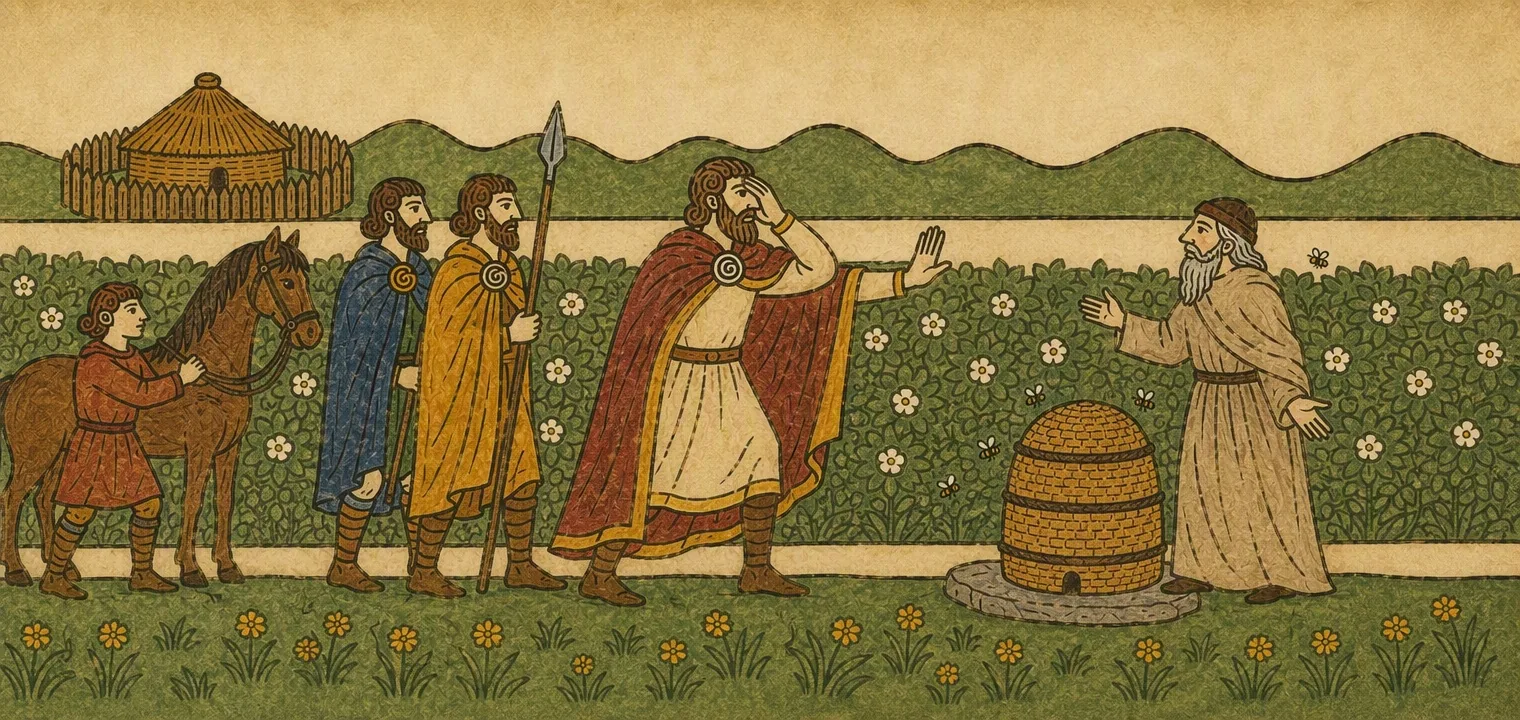
The man’s name was Congal, and the word that follows it, Cáech, means one-eyed. The law-text says that bees blinded him in one eye, and that the judgment given then was the first of its kind.
The law
From the lawBechbretha is the law of bees. Its author cared most about two things: how a new hive fits in among neighbours, and who owns a swarm. Harm done to people by bees interested him less, apart from the case of Congal. He is keen to treat bees like trespassing farm animals, and he also borrows from the law on trees. The text covers theft of bees as well.
From the lawThe bees were not to blame if they rushed a man who was robbing the hives, moving them, seizing a swarm, or looking over the hives while the bees were swarming. They were in the wrong if they attacked someone passing by who was doing them no harm. Such a man was owed a sufficiency of honey, which Kelly reads as a meal of honey, if he swore that he had not killed the bee that stung him. If he had killed it, the law treated the bee as having already paid for its offence.
GlossA honeybee normally dies soon after stinging, because its sting stays in the skin. The law-text does not mention this. A glossator does, and he holds that the man is still owed honey, since he did not himself kill the bee.
From the lawIf bees blinded an eye, lots were cast on all the hives, and the hive the lot fell on was forfeit for the offence of the one bee. Kelly says the hive then went to the injured man. A gloss says: one hive for blinding, two for killing. Sections 31 to 33 say this was the first judgment passed for the harm bees did to Congal Cáech, that the offence was charged on the man who owned bees nearby, and that it was the judgment of the Ulaid and the Féni. Section 34 gives the reason: it is one of the cases where a whole crowd answers for the offence of one, as when a carcase is found among dogs or pigs, or a man is killed in a crowd and no one can be named.
GlossThe editors set the lots beside a rule for a herd owned in common. If an animal is killed and the culprit cannot be found, a lot is cast on the whole herd and the animal it falls on is held responsible.
Weigh it
A bee blinds a man’s eye and no one can say which hive it came from. What does the law do?
The commentary
Scholars sayThe editors, Charles-Edwards and Kelly, date the text from its mention of Congal. He appears in the annals from 626 and died in 637 at the battle of Mag Rath. The law-text speaks of him as having lost the kingship of Tara, which the editors think probably happened not long before his death, so the text is later than that. They read its language as a little earlier than the eighth-century Würzburg glosses and suggest about the middle of the seventh century, with about 700 as the upper limit. Kelly adds that outside Bechbretha there is no early evidence that Congal was ever king of Tara, and that most leading cases named in the law-texts are legendary, while Congal was a real person.
Scholars sayThe editors think a blinding bee-sting is unlikely but not impossible. The eye shuts very fast and a honeybee's sting is shorter than an eyelid is thick, though venom might seep in. Kelly finds the case suspicious on several counts, and calls a single hive an extraordinarily lenient award. A later story says Congal was stung as a baby, but the law-text implies he was a grown man.
Where we are not sure
Scholars sayThe editors call the blinding unlikely but not impossible, and Kelly calls the verdict extraordinarily lenient and notes that Congal's kingship of Tara is not confirmed elsewhere (the editors call it plausible). The editors also give two date arguments, one from his loss of the kingship and one from the language. The gloss about two hives for killing is late commentary, and the editors note the text itself does not deal with a death. The source reports no dispute about the lots rule itself.
Where this comes from
- T. M. Charles-Edwards and Fergus Kelly, Bechbretha (Early Irish Law Series 1, Dublin Institute for Advanced Studies, 1983): the Old Irish text, English translation and notes for sections 27 to 34 and the dating. We read their translation, not the Old Irish.
- Fergus Kelly, Early Irish Farming (1997), on bees.
Last checked against these books: 2026-10-04. How we read our sources · Corrections