The court · Bretha Crólige, “Judgments of Blood-Lying”, between the late 7th and early 8th century
Nine Days’ Care
A man is wounded in a quarrel and cannot work. Who nurses him, and who pays?

The scene Our telling
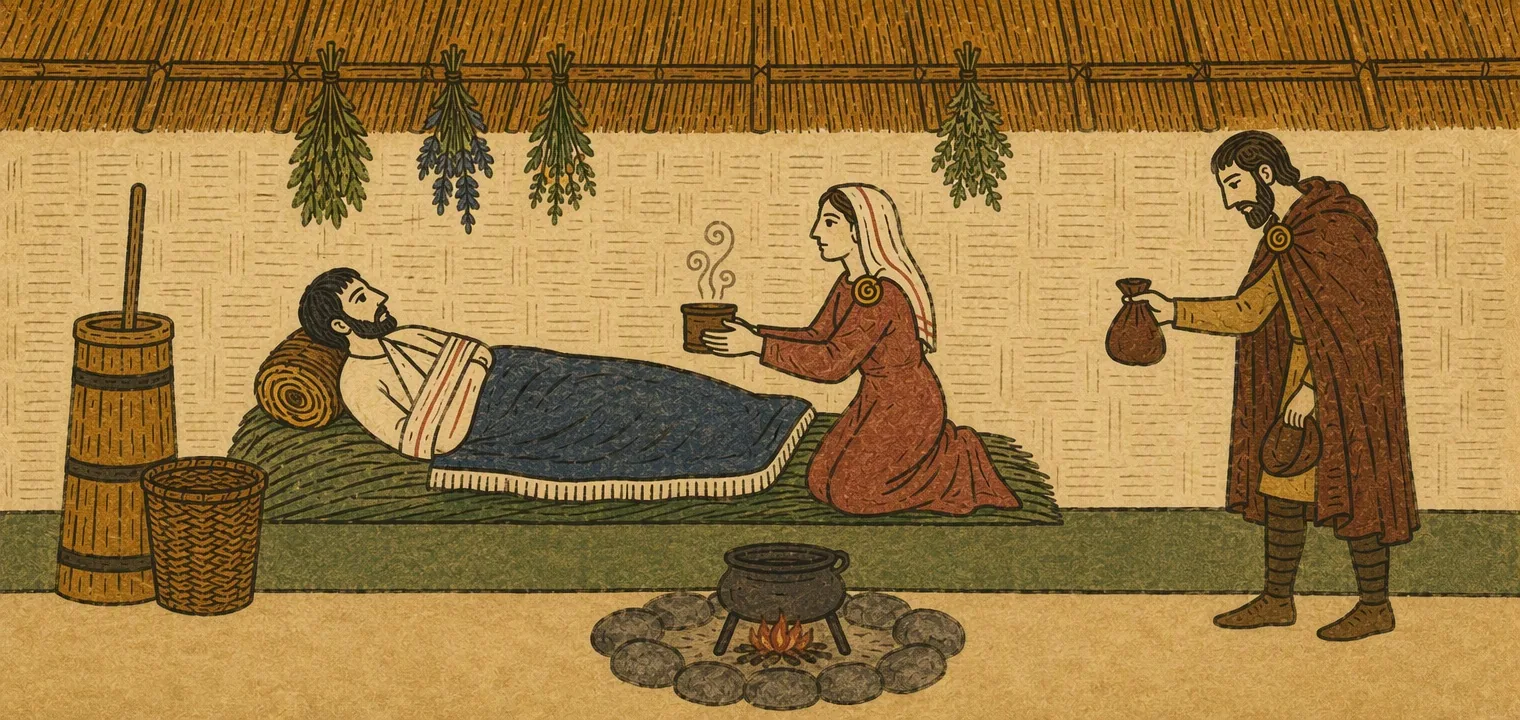
The blow came at a fair, over a debt of two sacks of malt. Ruadhán went down with his arm broken and did not get up. By the evening of the fourth day he could not hold a cup.
The law
From the lawWhen a man was wrongfully hurt, he was normally taken to his own home and cared for by his kin for nine days, doubtless with a physician overseeing. Should he die in that time, the man who hurt him owed the full penalties for a killing.
GlossMost sources give nine days before the physician's verdict. One section of Bretha Crólige says ten.
From the lawIf he was still alive after the nine days, a physician examined him. If he had recovered enough to need no more nursing, the culprit owed only for any lasting blemish or disability. If the physician thought recovery unlikely, the culprit owed the heavy fine called blood-lying of death. If the man would live but still needed nursing, the culprit had to take him away on sick-maintenance.
GlossThe physician’s verdict on the ninth day decided which of three payments applied.
From the lawSick-maintenance meant taking the injured man in a set form, in front of three lords, to the house of a third party, probably a kinsman of the culprit, and nursing him there at the culprit's cost until he was cured. The culprit and the victim's kin exchanged pledges, and Kelly says a surety backed the culprit's duties, though Bretha Crólige itself does not mention one. The culprit met the medical costs, the food and lodging for the victim and his retinue, and the cost of a substitute to do the victim's work. If the victim was married and of an age to have children, he also owed a further fine for the lost chance of conceiving.
GlossThe sick man’s house had rules: no fools or enemies admitted, no games, no shouting, no dogs set fighting, no children chastised. The text gives a long list.
From the lawAn injury that did not reduce the victim's capacity for work, action or movement carried no right to sick-maintenance, and no extra penalty of the after-judgment kind, only the ordinary fine for the injury.
GlossSick-maintenance was for injuries that actually disabled.
Weigh it
On the ninth day the physician says Ruadhán will live but still needs nursing. What happens?
The commentary
Scholars sayBretha Crólige is one of the texts of the Senchas Már, which Kelly says range from the 7th to the 8th century and were probably brought together before the middle of the 8th. Binchy edited it in 1938. Kelly's note says most sources give nine days, but one section of Bretha Crólige itself says ten.
Scholars sayNot every law-text agrees. Kelly notes that Críth Gablach says sick-maintenance was obsolete and had been replaced by fines. Kelly offers this as one example of a general problem. Such differences may come from a difference of date or of local custom, or from a clash of opinion between law-schools or even between lawyers in one school.
Where we are not sure
Scholars sayKelly says the texts are not explicit, but Binchy suggests that paying the blood-lying fine ends the culprit's further payments whether the victim lives or dies. Most sources give nine days and Bretha Crólige section 41 gives ten. The third-party house is only 'probably' a kinsman's. Bretha Crólige does not mention the surety. Críth Gablach calls sick-maintenance obsolete, replaced by fines.
Where this comes from
- Fergus Kelly, A Guide to Early Irish Law (Dublin Institute for Advanced Studies, 1988), the section on illegal injury and sick-maintenance, which cites Bretha Crólige §§41, 42 and 59 to 61.
- D. A. Binchy, “Bretha Crólige”, Ériu 12 (1938), the edition. We have not read it ourselves; the rules above come from Kelly’s account of it.
Last checked against these books: 2026-10-04. How we read our sources · Corrections