The court · Bretha Étgid, “Judgments of Inadvertence”, the 7th and 8th centuries
The Overloaded Ferry
A ferry sinks and a passenger drowns. Does the ferryman pay?
The scene Our telling
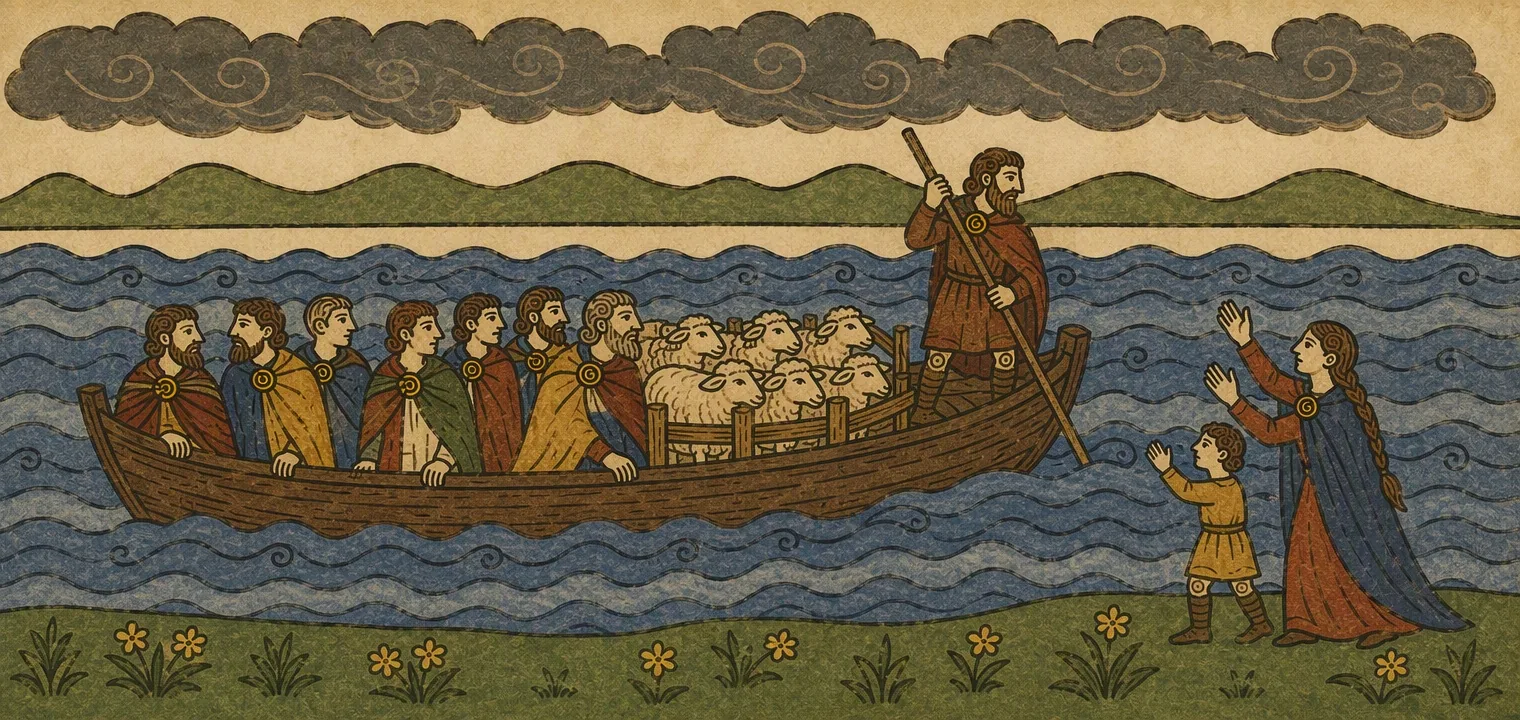
Cathal’s boat took forty sheep and nine men across the river on the fair-day morning. It was a stormy morning, and the river was high.
The law
From the lawKelly says that a person who travels in a ferryboat is felt to have willingly taken on the risk of accidental death or injury. The boat’s owner is liable only if he sets out overloaded or in stormy weather.
GlossThe idea is that the traveller accepted the risk. That is Kelly’s reading of the rule.
From the lawThe same reasoning is applied to a fair, though Kelly is more cautious there: a person attending a fair is evidently felt to have accepted the risk of being killed or injured by horses or chariots, and there is no recompense for such accidents.
GlossThe ferry owner’s exception is setting out overloaded or in stormy weather. Kelly gives no definition of either.
From the lawBretha Étgid gives only the briefest description of each accident, but it is usually clear what is meant. Among the accidents with no liability are going too near a blacksmith at work (the “immunity of hammers”), a flail at a drying kiln, a flying chip in carpentry and a mill while milling. Among those with liability are a tool with a defect that was not announced to those nearby, a tree-cutter who fails to shout a warning, and a person who lifts meat from a cauldron with a flesh-fork without warning.
Gloss“No liability” means the person whose act or tool caused the harm owes no fine and no compensation.
Weigh it
Cathal set out overloaded, in a storm. Is he liable for the drowning?
The commentary
Scholars sayKelly gives the ferry rule in a single sentence. He does not say what counts as overloaded or stormy, what the owner must pay, or whom he pays.
Where we are not sure
Scholars sayKelly’s reasons, that travellers are felt to have accepted the risk and that those at a fair are evidently felt to have done so, are his reading of the rules, not reasons he quotes from the text. He introduces the immunity of hammers with “presumably”. The ferry rule is cited at CIH 271.14–272.1 and the fair rule at CIH 265.41 and 283.28. In the old translation the tract was printed under the wrong title, “Lebar Aicle”, which matters to anyone looking it up in Ancient Laws of Ireland, volume iii.
Where this comes from
- Fergus Kelly, A Guide to Early Irish Law (Dublin Institute for Advanced Studies, 1988), the section on accidents, citing Bretha Étgid at CIH 271.14–272.1 (the ferry) and CIH 265.41 and 283.28 (the fair).
- We have read Kelly’s account, not the Old Irish text.
Last checked against these books: 2026-10-04. How we read our sources · Corrections