The court · Mellbretha, “Sport Judgments”, the 7th and 8th centuries
The Boys’ Games
A boy is hurt at a game. Who owes him?
The scene Our telling
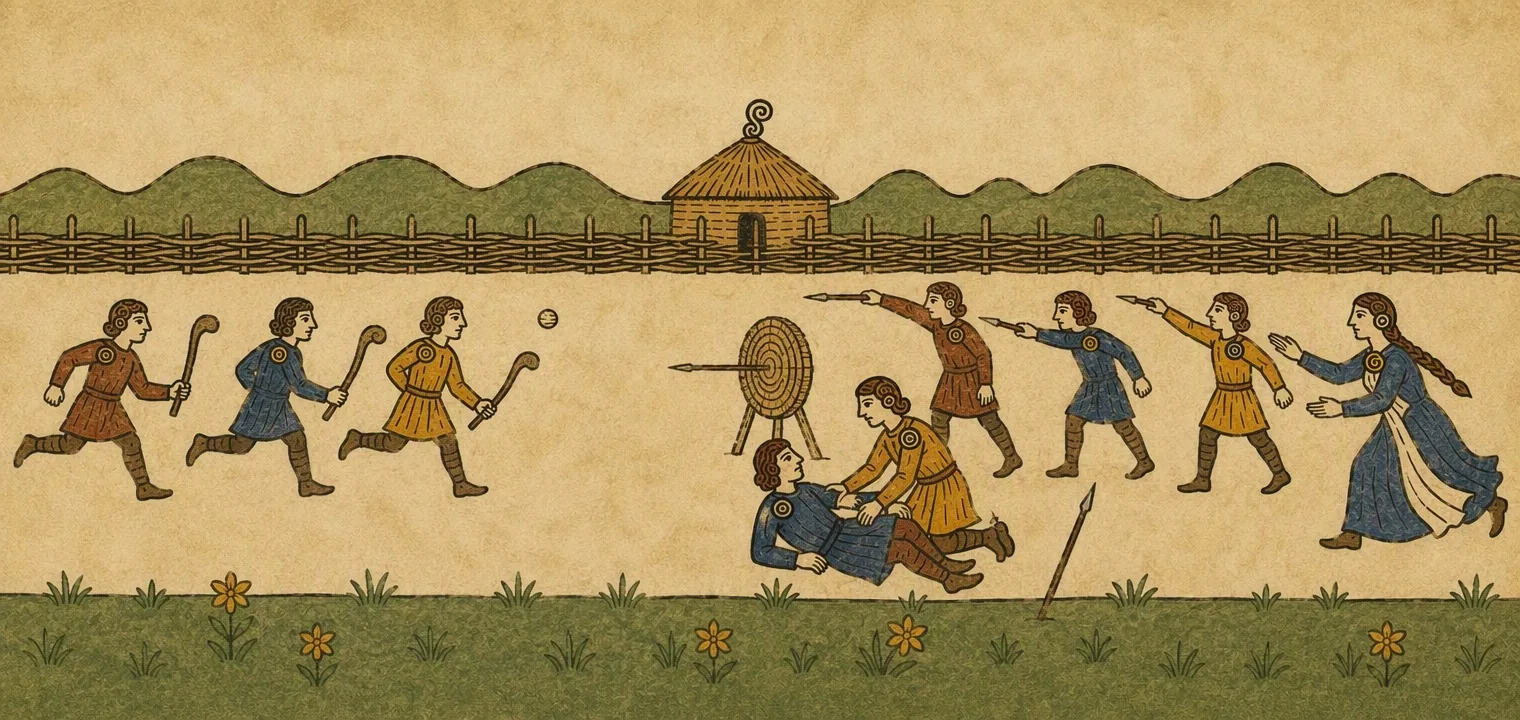
The boys had been out since morning. They played hurling on the long field, and at midday one of them proposed a different game, with spears.
The law
From the lawKelly says a boy hurt in most games has no right to a fine or to sick-maintenance. His examples come from Mellbretha, a text that survives only in fragments: hurling, jumping, swimming, hide-and-seek and juggling. The list is only a sample.
GlossSick-maintenance means nursing the hurt person at the wrongdoer’s cost until he is cured, instead of simply paying a fine.
From the lawThe dangerous games that imitate war, such as throwing spears or hurling rocks, are treated differently. There the culprit’s kin apparently have to provide sick-maintenance for the injured boy.
GlossKelly’s list ends with “etc.”, so these are samples of the games and not a complete rule-book.
From the lawA quotation that Kelly thinks is no doubt from Mellbretha lists four “guilty games”, among them throwing a wooden javelin into a crowd and an uneven contest of few against many. Kelly thinks it likely, as Binchy suggests, that these carry both a fine and sick-maintenance.
From the lawElsewhere Kelly describes sick-maintenance (othrus) for an innocent person who is injured. The culprit has to bring him to a house, probably one belonging to a kinsman of the culprit, and nurse him there at his own cost until he is cured, with food and a substitute to do his work. Kelly does not say this was applied to injuries at games.
Weigh it
A boy is wounded in the game of throwing spears. What does the law say?
The commentary
Scholars sayMellbretha survives only as a fragment, so Kelly’s account is partial. His word “apparently” marks his own uncertainty about the kin’s duty.
Where we are not sure
Scholars sayKelly is not certain where the quotation about the four guilty games comes from, and he rests the fine on Binchy’s suggestion. The Old Irish names of the two kinds of game are not clear in the copy we have, so we have not used them.
Where this comes from
- Fergus Kelly, A Guide to Early Irish Law (Dublin Institute for Advanced Studies, 1988), the section on accidents, citing Mellbretha (Appendix 1, no. 34, edited by Binchy in Celtica 8, 1968).
- We have read Kelly’s account, not the Old Irish text.
Last checked against these books: 2026-10-04. How we read our sources · Corrections