The court · the short text on distraint, the 7th and 8th centuries
Distraint on the Physician
A physician owes a debt and will not pay. What does the plaintiff do?
The scene Our telling
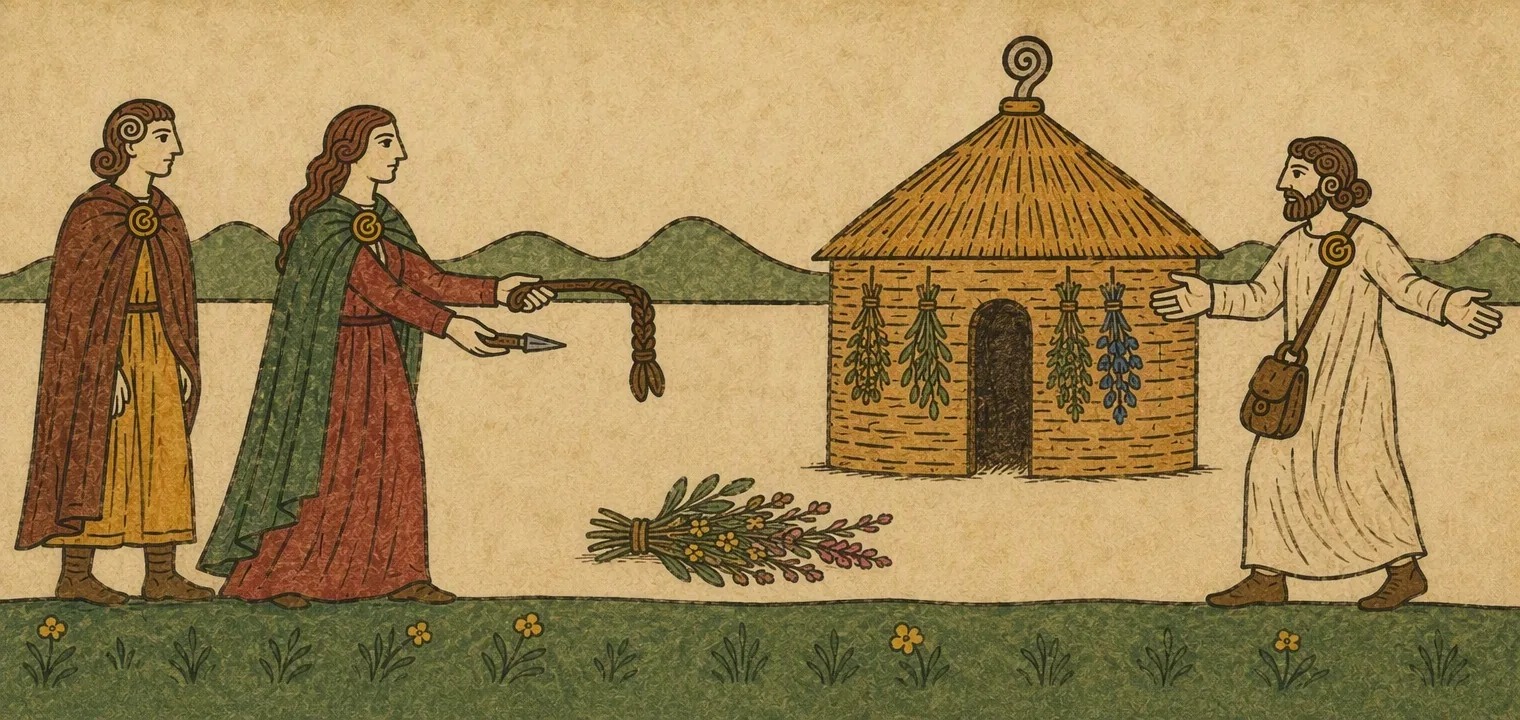
Brigh was owed for a mare by the physician at Cluain. He did not deny it. He said he would see, and then he went out on his round.
The law
From the lawKelly says the short text on distraint also gives the steps for several kinds of dependent professional, called dóernemid. The plaintiff ties a withe round a smith's anvil and tells him he must make nothing on it until he agrees to do justice. If the smith goes on working, his goods can be distrained in the usual way. A similar procedure is used for wrights, welders and workers with adze or axe.
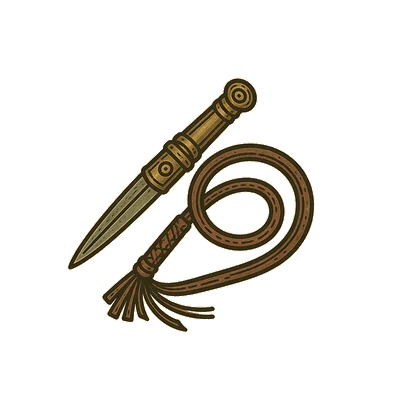
GlossIn each case the formal step is aimed at the tools of the trade: the anvil for the smith, the horse-whip and lancet for the physician.
From the lawFor a physician the formal steps are generally aimed at his professional equipment. The plaintiff carries off his horse-whip (the word may be a scribal change, see below) and his lancet. If the text means the physician has no medicine-bag on him, the plaintiff ties a thread round the finger next to the little finger.
GlossKelly does not say why these tools were chosen.
From the lawIf the physician refuses to concede justice after these formalities, he is guilty of evasion of a legal obligation, and in the end loses his honour-price.
Weigh it
Brigh has given notice and the physician still refuses. What has she done, and what comes next?
The commentary
Scholars sayKelly notes that the text does not say what happens if the physician has a medicine-bag, which one would normally expect. Presumably the plaintiff would take it away or lay a withe across it.
Scholars sayIn a note Kelly adds that Binchy thinks the horse-whip in the text may be a scribal change for a word meaning a special staff carried as a sign of office. Kelly himself suggests that taking the whip may have meant the physician was barred from using his horse, which he compares to a modern doctor whose driving licence has been withdrawn.
Where we are not sure
Scholars sayKelly notes that the text 'does not say what the procedure is if the physician has a medicine-bag'. He supplies 'presumably' the plaintiff would take the bag or lay a withe across it. He also reports Binchy's idea that 'horse-whip' may be a scribal change for a staff of office, and offers his own alternative reading. He notes no dispute over the rest.
Where this comes from
- Fergus Kelly, A Guide to Early Irish Law (1988), chapter 7, “Distraint and legal entry”, on distraint of the dóernemid, p. 181, citing the 'text on the forms of distraint' (Appendix 1, no. 67; edited by Binchy in Celtica 10 (1973) 72–86, physician passage at p. 83). Kelly's notes place this text at about CIH 897.30 to 898.32; he gives no CIH line for the physician passage.
- We have read Kelly’s account, not the Old Irish text.
Last checked against these books: 2026-10-04. How we read our sources · Corrections