The court · Kelly's account of the restrictions on distraint (drawing on the Heptads and a shorter text on distraint), the 7th and 8th centuries
The Cow That Had Just Calved
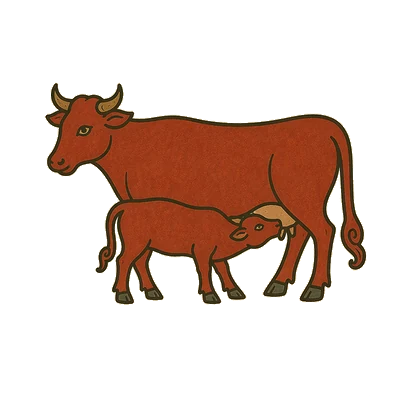
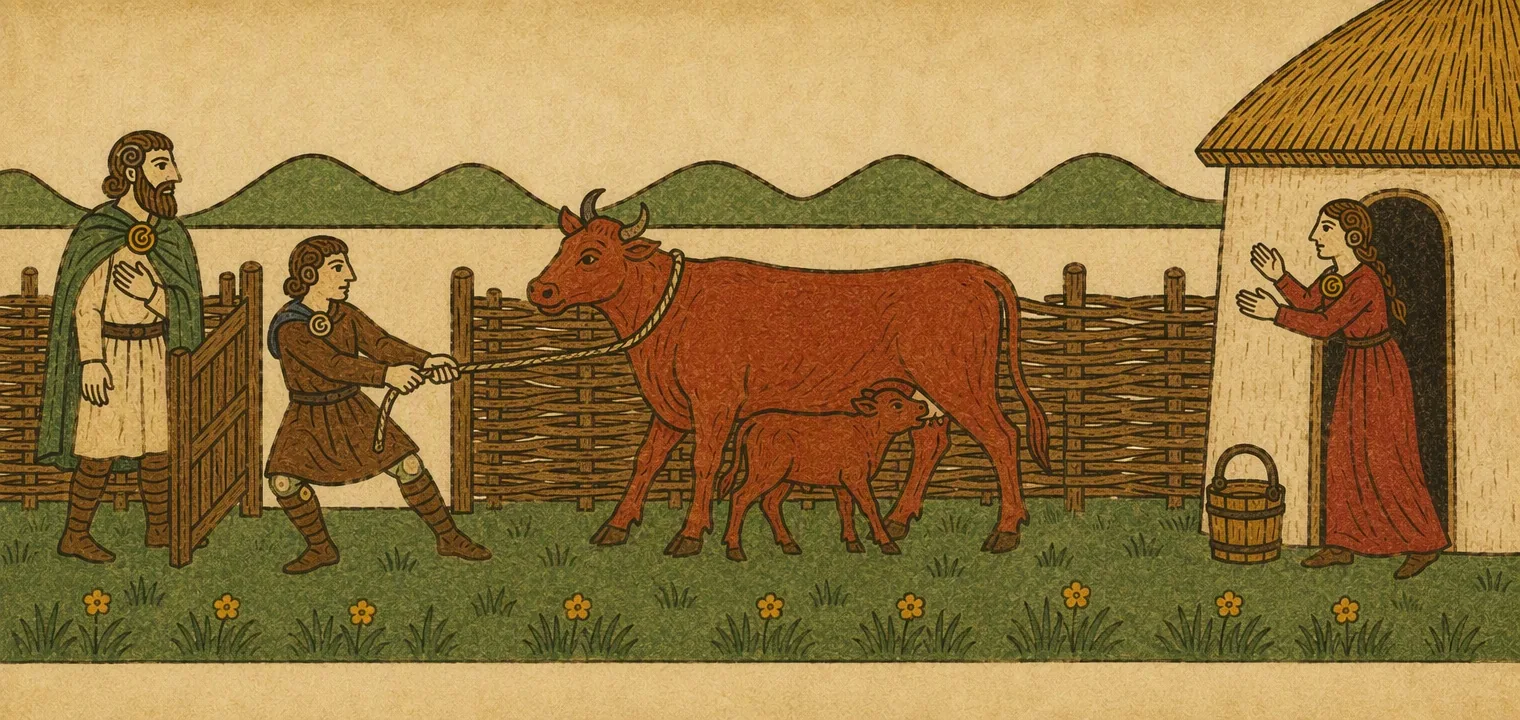
A creditor drives off a cow that has just calved. Is that lawful distraint?
The scene Our telling
Seán was owed for a plough-share, and he came with a witness at first light. In the paddock he found the red cow, her calf at her side, and he drove her out through the gate.
The law
From the lawKelly says the law set limits on which animals could be taken, with the aim of causing the defendant as little hardship as possible. The list includes a cow that has just calved, a cow due as rent to a lord or church, a bull during the time the cows are in heat, a horse wanted for racing, oxen wanted for ploughing, and pigs being fattened. Kelly's list ends with 'etc.', so it may not be complete.
GlossKelly says the aim of these animal restrictions is to cause the defendant 'the minimum of hardship or inconvenience'.
From the lawKelly says the rules on distraint were complicated, and that a plaintiff who misjudged them could be liable to the fine of five sets for improper distraint. He does not say that this fine applies to each of the animal restrictions.
From the lawIt is also an offence to distrain on a holy day, across a boundary except in time of war, or on the stock of a person who is moving house, unless he is a thief or fugitive. No son can distrain his father's property.
GlossThese are further limits Kelly lists beside the animal restrictions.
Weigh it
Seán has driven off the cow that had just calved. What has he done?
The commentary
Scholars sayKelly notes that a wide range of livestock would be ineligible for distraint at any one time. But such animals might be distrained for their own offences, and he gives the shorter text's mention of distraining oxen at ploughing-time as an example.
Scholars sayBecause the rules were complex, professional lawyers played an important part in distraint. Di Chethairshlicht Athgabálae says the plaintiff should get a man skilled in speech to oversee what he does. Kelly takes this to be the aigne, an advocate or law-agent, who received a third of the amount distrained (Kelly cites another text for that fee). The advocate was not fined for the 'three mistakes of an aigne' if he acted in good faith. Kelly suggests the plaintiff would himself pay the fine if he had knowingly misled his advocate.
Where we are not sure
Scholars sayKelly gives the restrictions as a list ending in 'etc.' and says they aim at 'the minimum of hardship'. He notes no dispute about the cow rule, but gives no reason beyond that. He reads the horse of 'a man who strives for the honour of the tuath' with 'presumably', and he says only 'presumably' the plaintiff would pay the fine if he had misled his advocate. The passage does not say what happens to the calf. Our reference for the Heptad that holds the cow rule is not given in the OCR we have.
Where this comes from
- Fergus Kelly, A Guide to Early Irish Law (1988), chapter 7, “Distraint and legal entry”, pp. 183 to 186, citing CIH 38.19–21 (the cow just calved and the cow due as rent), CIH 897.15 to 897.20 (the shorter text: bull, horse, oxen, pigs) and CIH 359.34 (the fine of five sets in Di Chethairshlicht Athgabálae).
- We have read Kelly’s account, not the Old Irish text.
Last checked against these books: 2026-10-04. How we read our sources · Corrections