The court · Di Chethairshlicht Athgabálae, “On the Four Divisions of Distraint”, the 7th and 8th centuries
Fasting upon a Lord
A woman is owed a debt by a lord, and the lord will not pay. What can she do?
The scene Our telling
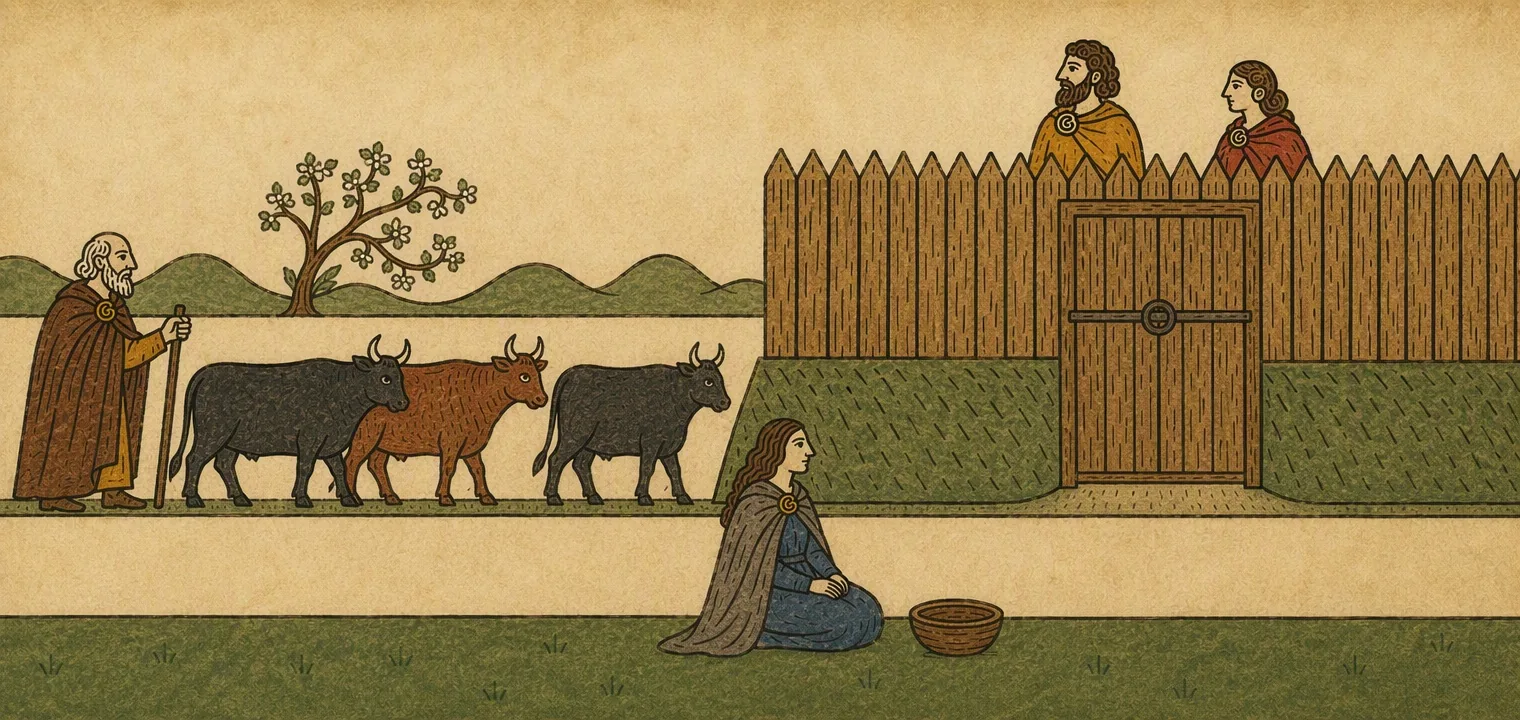
Muireann had sold a lord’s steward a cow on his word. A year later the cow had not been paid for, and the steward only shrugged. On the morning she went up to the lord’s house she took no breakfast, and she sat down by his door.
The law
From the lawOrdinary debts were enforced by distraint. The creditor gave notice, then waited one, two, three or five days, then took cattle worth the debt and kept them in a pound, where they were forfeited a little each day if the debt stayed unpaid. Against a person of high rank, of the privileged class called nemed, the creditor first had to fast. This probably took place outside the nemed's house, and distraint could follow it.
GlossKelly says the aim was to press a powerful person by moral force, since an ordinary distraint was harder to carry out against a person of full nemed rank.
From the lawThe nemed was expected to promise justice by naming a surety or by handing over a household article as a pledge. If he ate during the fast without making any such promise, he owed double the original debt. If the plaintiff went on fasting after the nemed had offered to settle, the case fell. Kelly adds that a nemed who held out against a justified and properly conducted fast, presumably by resisting the distraint that followed, lost his right to be paid for wrongs done to him.
GlossKelly says that a nemed who lost his right to payment was in effect deprived of his legal rights in society.
From the lawLater commentary allows the nemed a three-day respite after the fast before distraint is permitted. If the nemed has a substitute churl, the plaintiff must distrain the churl's property, and he pays the fine for illegal distraint if he takes the nemed's instead.
GlossFasting opened the way to distraint rather than replacing it.
Weigh it
The lord eats his supper while Muireann fasts at his door, and gives no surety or pledge. What does he owe?
The commentary
Scholars sayThe main text does not say how long a fast lasted. Later commentators take it to be only from sundown to sunrise, so that the nemed misses his main evening meal, rather than a fast until death or settlement.
Scholars sayKelly distinguishes this legal fasting from a political hunger strike, though both aim to press a more powerful opponent by moral force. He notes that legal fasting is also known from early Indian law.
Where we are not sure
Scholars sayKelly says the text does not state how long a fast lasted, that later commentators take it to run from sundown to sunrise, and that it is unclear how soon distraint may follow the fast (later commentary allows three days). He gives 'probably' for the fast taking place outside the house and 'presumably' for how the nemed holds out. We have not read the Old Irish and the source notes no dispute over the double penalty.
Where this comes from
- Fergus Kelly, A Guide to Early Irish Law (Dublin Institute for Advanced Studies, 1988), chapter 7, “Distraint and legal entry”, on distraint and fasting. He cites the text at CIH 365.5 to 367.7 and Thurneysen’s edition (Zeitschrift für celtische Philologie 15, 1925) and Binchy in Celtica 10 (1973).
Last checked against these books: 2026-10-04. How we read our sources · Corrections