The court · Kelly’s account of contracts, from Berrad Airechta and Di Astud Chor, law-texts of the 7th and 8th centuries
The Bargain Made in Drink
A man sells his best mare at a feast, while drunk. Is the sale binding?
Basis. Rests on Kelly’s account of the law, not on the Old Irish text itself. Open questions are set out below.
Topics: Debt.
The scene Our telling
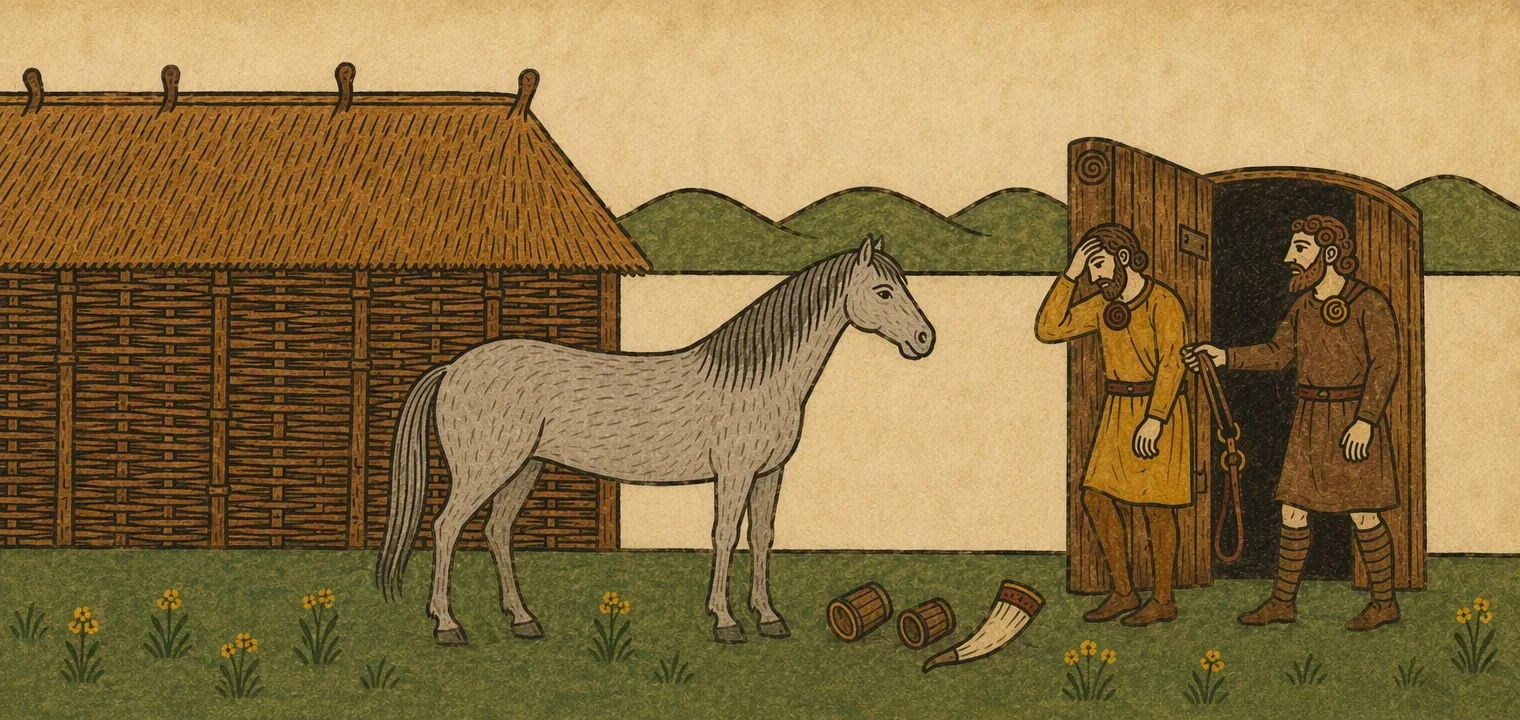
The feast at Cenn Locha had gone on past midnight. Muirchertach had told everyone how fine his grey mare was, and Lugaid had said that he would buy her. A price was named, loudly, and agreed with a slap of hands, and two men at the table called out that they would stand surety. Someone filled the cups again.
 The feast at Cenn Locha had gone on past midnight. Muirchertach had told everyone how fine his grey mare was, and Lugaid had said that he would buy her. A price was named, loudly, and agreed with a slap of hands, and two men at the table called out that they would stand
In the morning Muirchertach woke with a sore head and no memory of any bargain. Lugaid was at the door with a halter in his hand. The grey mare stood in the yard behind him, as calm as ever. Neither man could quite look at the other.
What would you decide?
Answer first, then read the law. Your first answer is the one kept. It is stored only on this device.
Is Muirchertach bound to hand over the mare?
Read the law below and find the line that decides it. Is it a rule you would have guessed?
Read the law, the commentary and the sources
The law
The law, as Kelly gives itA contract made when either party was drunk was normally invalid.
NoteA legal commentary defines drunkenness as not being able to remember the previous night’s events in the morning.
The law, as Kelly gives itAny contract could be undone for a short time. Until sunset on the day it was made, either party could change his mind and cancel it. After that, a contract that had been properly witnessed and bound by sureties could not be undone, whether it turned out well or badly for either side.
NoteKelly gives this as the rule for contracts in general. It does not depend on drink.
The law, as Kelly gives itThere were exceptions. A contract about joint ploughing, clientship or the law of neighbourhood was valid even though it was made in drink. Kelly says such arrangements were evidently made regularly at feasts or in an ale-house.
The law, as Kelly gives itOther things made a contract invalid too. A contract made under duress, in fear or in ignorance was invalid, and a lunatic could not make a valid contract in his own right.
The law, as Kelly gives itKelly found no evidence that a killing or an injury done under the influence of drink was treated more leniently than one done sober.
The commentary
Scholars sayTecosca Cormaic, a text of advice, tells its hearer not to buy from a drunk. Kelly cites it beside the rule on contracts. It is a saying and not a law, and it shows the same idea.
Where we are not sure
Scholars sayKelly does not say how a court decided whether a person had been drunk enough, or how the commentary’s test could be applied. The test is a later commentator’s, not the law-text’s.
Scholars sayThe feast ran past midnight, and we cannot say which day’s sunset would have ended the time for crying off. Kelly gives the sunset rule without that detail.
Where this comes from
- Fergus Kelly, A Guide to Early Irish Law (1988), p. 154 on drunkenness and pp. 158 to 160 on contracts, on cancelling one before sunset and on the contracts that are invalid, citing Berrad Airechta §17 and Di Astud Chor §21 for the rule, with Tecosca Cormaic §19 and the commentary at CIH 2159.27, which defines drunkenness.
- We have read Kelly’s account, not the Old Irish text.
Last checked against these books: 2026-10-06. How we read our sources · Corrections