The court · Heptads 13, 14 and 33 and Bretha Nemed Déidenach, the law of satire, law-texts of the 7th and 8th centuries
The Poet’s Warning
Draft case. It is to be checked against its sources before the site opens.
A lord will not pay what he owes. When may a poet lawfully turn to satire?
The scene Our telling
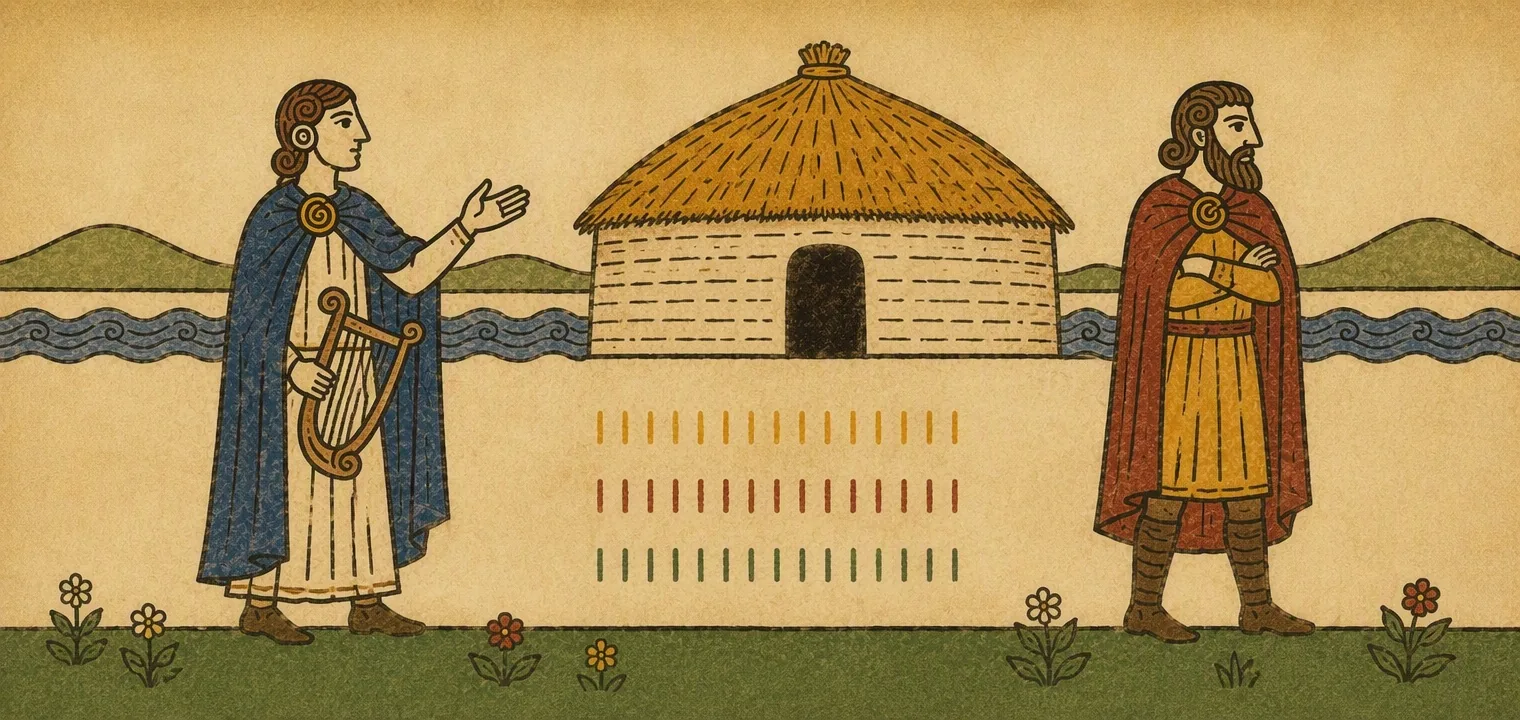
Brigit had sold the lord’s steward six sheep and had never been paid. No one in the district would distrain upon a lord. She sent for a poet.
The law
From the lawA poet of full rank could lawfully use satire to press a wrongdoer to obey the law. Satire with no just cause was a serious offence, and the satirist paid the victim’s honour-price. So too did satirising a person after death, and so did a range of insults: mocking a person’s looks or a blemish, a nickname that stuck, repeating a satire made elsewhere.
GlossA poet’s words could ruin a name, so the law made the poets answer for how they used them.
From the lawIf the satire was justified, the person satirised had to pay what he owed, or give a pledge to save his honour. A king or lord who put up with justified satire and did nothing lost his honour-price.
GlossThe law does not leave a lord free to ignore a justified satire. His honour-price is what he stands to lose.
Scholars sayThere was also a set procedure, called the trefocal, taking thirty days. In the first ten the poet warned the debtor. In the next ten he recited a mixture of praise and satire. In the last ten the debtor had grace to give a pledge, and if it was still unpaid, full satire followed.
GlossThe mixed praise and satire in the middle was a warning, a sample of what the full satire would be.
Weigh it
When may the poet recite the full satire?
The commentary
Scholars sayKelly’s Guide says nothing of the thirty days. It does list a lost tract on the trefocal by Cináed Úa Con Mind, and the Companion to the Corpus Iuris Hibernici mentions fragments of it among extracts on satire.
Scholars sayThe account of the thirty days comes from a lawyer’s essay that follows the scholar John Biggins. The sources behind it include the work of Robin Chapman Stacey (Dark Speech, 2007) and Roisin McLaughlin (Early Irish Satire, 2008). We have not yet checked it against them.
Where this comes from
- Fergus Kelly, A Guide to Early Irish Law (1988), on the poet and satire and on verbal assault, citing Heptads 13, 14 and 33 and Bretha Nemed Déidenach.
- The Brehon Lawyer, “Early Irish ‘Influencers’? Poets, Speech and Accountability under the Brehon Laws” (2021), which follows John Biggins, for the thirty days. A secondary account.
- The thirty days and the three periods of ten are still to be checked against Stacey, Dark Speech, or the text itself.
Not yet checked against its sources. How we read our sources · Corrections