The court · Di Astud Chirt 7 Dligid, “On the Confirmation of Right and Law” (CIH 242.17 to 18), as Kelly reads it with a gloss, the 7th and 8th centuries
The Craving
A pregnant woman takes a handful of her neighbour’s barley. Is it theft?
The scene Our telling
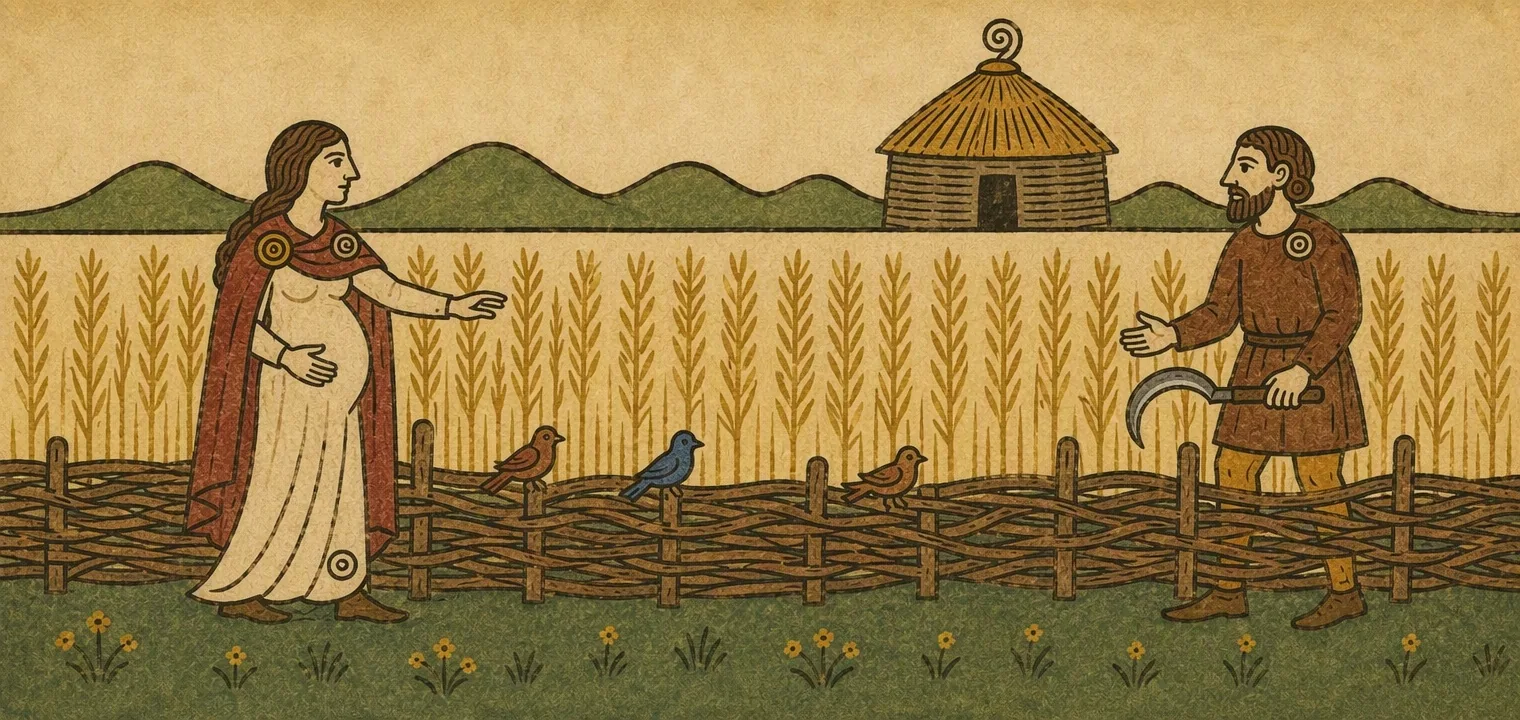
Fedelm was seven months gone and could think of nothing but the taste of fresh barley cake. On the way home from the well she reached over her neighbour’s wall and took a handful of the new grain. The neighbour saw her, and said nothing until evening.
The law
From the lawKelly says a penalty could be cancelled when the offence was committed under mental or physical stress. Someone in fear of danger might borrow another's horse, weapon or boat without leave. A hungry down-and-out was not guilty for taking a piece of food. Herbs for an invalid's broth could be taken without penalty, and so could a desired morsel of food, which a glossator says means the longing of a pregnant woman.
GlossKelly says in Early Irish Farming that the rule that an invalid may have the food he longs for was extended to the sudden craving of a pregnant woman, which is known medically as pica.
From the lawIf the food an invalid longed for was not to be had at home, he had a legal claim to get it from a neighbour.
GlossThe craving of the sick was met by the neighbours.
Weigh it
Is Fedelm liable for the barley?
The commentary
Scholars sayThe text says 'morsel', and Kelly's account gives no wider allowance. He follows a glossator in taking the Old Irish phrase, mír mein, as a morsel of food desired by a pregnant woman. The Bechbretha editors read the same phrase as a desired morsel for an invalid. A related phrase, mían ngalair, 'the desire of sickness', appears in Bechbretha: during a new hive's three years of immunity an invalid, presumably from the neighbouring lands, could still have honey.
Scholars sayThe sources we have say nothing of a husband’s duty to meet his wife’s cravings, so none is stated here.
Where we are not sure
Scholars sayThe law-text says only 'desired morsel' (mír mein). The pregnant woman comes from a glossator, which Kelly follows, while the Bechbretha editors gloss the same phrase as for an invalid. The sources give no size limit, do not mention grain, and say nothing we found about a husband's duty. We have not read the Old Irish.
Where this comes from
- Fergus Kelly, A Guide to Early Irish Law (1988), the section on stress and necessity, citing CIH 242.17 and the gloss at CIH 387.34.
- T. M. Charles-Edwards and Fergus Kelly, Bechbretha (1983), the note on the Old Irish phrase mían ngalair, “desire of sickness”.
- The Old Irish text we have not read ourselves. The rule rests on a short line in Kelly's Guide, with fuller notes on the gloss and commentary in his Early Irish Farming (about p. 350), which we have only used in part.
Last checked against these books: 2026-10-04. How we read our sources · Corrections