The court · Davies’s Reports, an English court in Dublin, 1608
The Case of Tanistry
Draft case. It is to be checked against its sources before the site opens.
Who inherits land: the eldest son, or the most worthy man of the kin?
The law
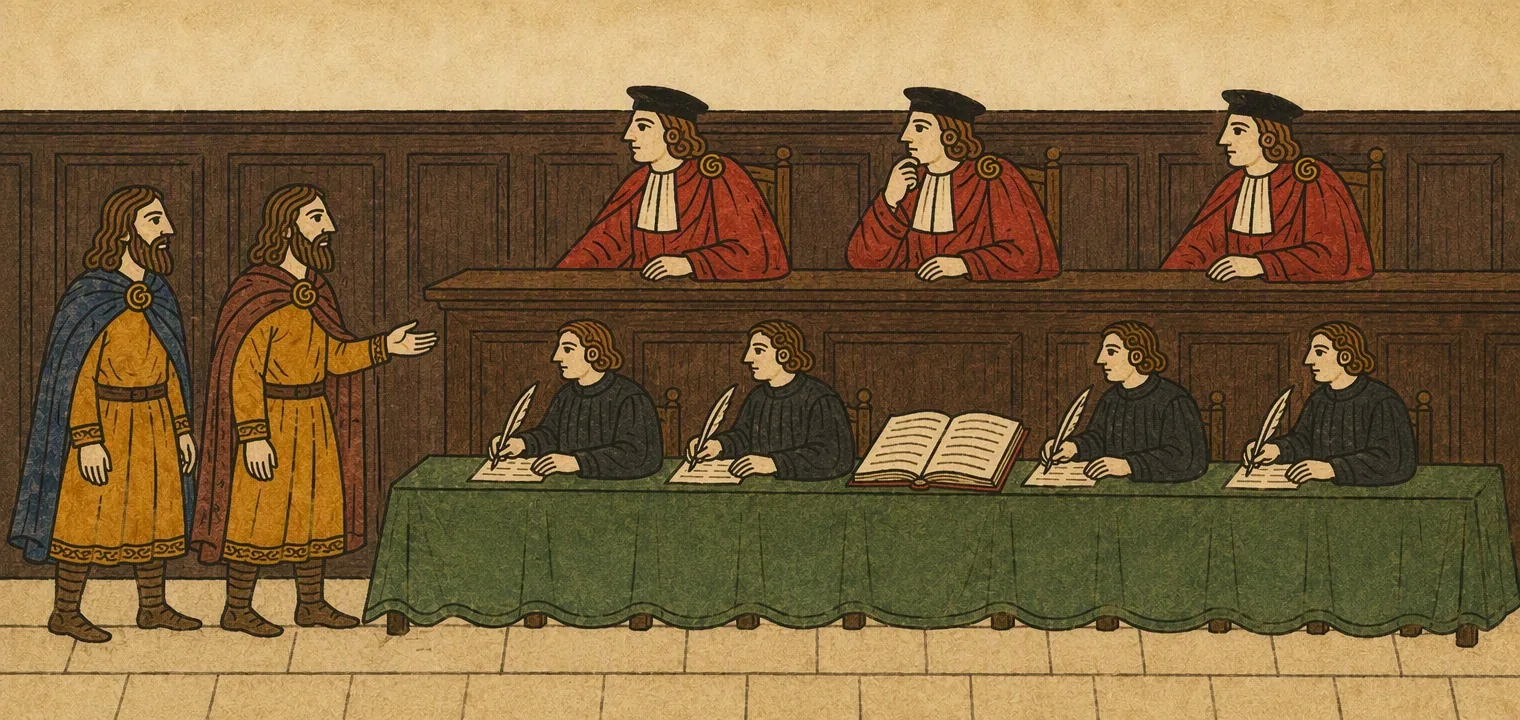
From the recordThis is not a Brehon law-text. It is a report of an English court judging the old Irish way of inheriting land. The parties were Murrough Mac Bryan and Donogh Mac Teige Callaghan, who each claimed land in County Cork.
GlossThe report was written by counsel for one side. The Irish custom is described only as the English court wrote it down.
From the recordThe Irish custom, tanistry, passed land through the male line to the most worthy man of the wider kin, not to the eldest son. The English law of the time gave land to the eldest son.
GlossThe “most worthy” rule left room for the kin to choose, and the court counted that as a flaw.
From the recordThe court held the custom void from the start. It called it unreasonable, uncertain, because no one could say who the most worthy man was, and broken once the land was granted under English law.
GlossWith the custom void, the courts would no longer recognise it.
Weigh it
Did the court honour tanistry?
The commentary
Scholars saySir John Davies, who reported the case, was the Crown’s Solicitor-General in Ireland and acted for one side. He drew the report from several judgments given over three or four years, and does not keep the parties’ arguments apart from the court’s ruling.
Where this comes from
- The Case of Tanistry (Le Case de Tanistry), Davies’s Reports, published in the early 17th century; read through the summary on the Brehon Academy site. The report itself is not yet read by us at first hand.
Not yet checked against its sources. How we read our sources · Corrections